
DeepSeek
AI intelligent assistant and open source large model launched by Magic Square Quantification
A look at DeepSeek
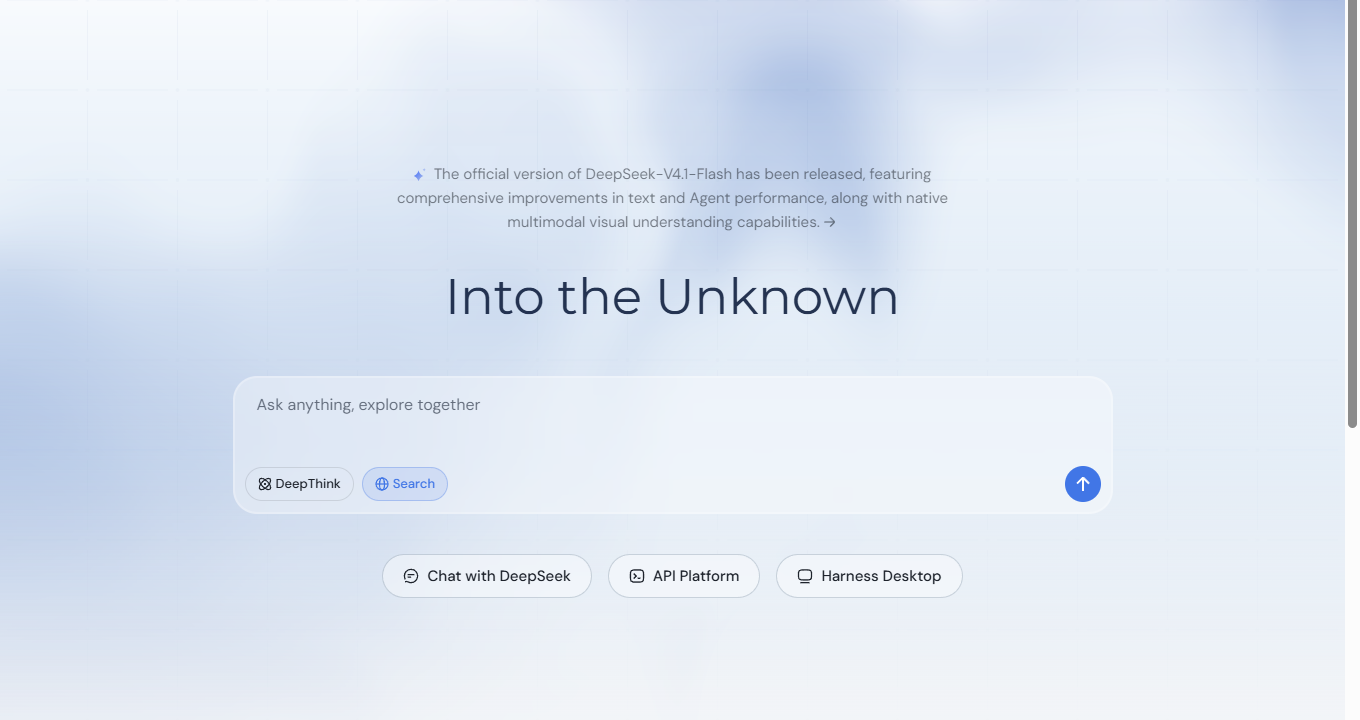
About DeepSeek
What is DeepSeek
DeepSeek is an artificial intelligence company owned by Huifang Quantification, which is an open source large model and AI intelligent assistant independently developed by DeepSeek. It focuses on the research and development of the underlying models and technologies of general artificial intelligence (AGI) and explores the implementation path of AGI. DeepSeek has launched multiple open source large language models, such as DeepSeek-V3 and DeepSeek-R1, which benchmark GPT-4o and OpenAI's o1 model respectively. Models perform well in reasoning, mathematics, and programming capabilities, and training costs are well below the industry average. It has a wide range of applications, covering intelligent dialogue, text generation, semantic understanding, code generation and other fields, and supports functions such as online search and in-depth thinking.
DeepSeek’s main features
- Intelligent Q&A and dialogue: DeepSeek can quickly answer various questions, covering scientific knowledge, history and culture, common sense of life and technical issues, etc. It supports multiple rounds of dialogue interaction, understands the context and gives coherent answers.
- Text creation: can generate various types of text content such as articles, stories, poems, reports, emails, etc.
- Language translation: Supports translation between multiple languages.
- Data processing: can process and clean data and perform statistical analysis.
- Visual chart generation: Convert data into intuitive visual charts such as bar charts, line charts, and pie charts.
- Code generation: Generate code based on natural language description, supporting multiple programming languages.
- Code debugging and optimization: Help developers quickly locate and solve problems.
- Mathematical calculation and reasoning: DeepSeek excels in mathematical calculation and logical reasoning, and can handle complex mathematical problems.
- Internet search and real-time information acquisition: Through the Internet search function, DeepSeek can capture the latest information on the Internet in real time, helping users obtain the latest data and dynamics.
- Deep thinking and complex problem solving: Deep thinking mode (R1) can handle complex logical reasoning and multi-step analysis problems.
- Intelligent customer service and automated services: DeepSeek can be integrated into various systems to provide intelligent customer service support and improve service efficiency.
- Large model development and management: DeepSeek provides a large model development platform that supports model training, management, data set control and other functions.
- Image recognition mode: Users can upload images for AI to perform in-depth visual understanding and interaction.
DeepSeek’s open source model
- Universal large language model DeepSeek-V3: adopts hybrid expert (MoE) architecture, with a total parameter size of 671B and 37B activation parameters. The model performs well in mathematics, coding and other tasks, supports 128K long context, and has a generation speed of 60 TPS. DeepSeek-V3-Base: The same architecture as DeepSeek-V3, providing native FP8 weights and supporting multiple inference frameworks. DeepSeek-V3.2: The official version of DeepSeek open source V3.2. The model is continuously trained based on DeepSeek-V3.1-Terminus. It only introduces DSA in the architecture, implements a fine-grained sparse attention mechanism, and uses the lightning indexer to efficiently select key information, greatly improving efficiency in long text training and inference.
- Inference optimization model DeepSeek-R1: Based on DeepSeek-V3-Base training, it optimizes reasoning capabilities through reinforcement learning and performs outstandingly in mathematics, programming and natural language reasoning tasks. DeepSeek-R1-Zero: A reinforcement learning model that does not use supervised fine-tuning and has strong reasoning capabilities, but there are challenges in readability and other aspects. DeepSeek-R1-Distill: Distillation optimization of small models based on inference data generated by DeepSeek-R1, covering different sizes such as 1.5B, 7B, 8B, 14B, 32B and 70B. DeepSeek-R1-0528: It is the latest version of the AI model launched by DeepSeek. The model is trained based on DeepSeek-V3-0324, with a parameter size of 660B. Core highlights include deep reasoning capabilities, optimized text generation, unique reasoning styles, and single-tasking capabilities of up to 30-60 minutes.
- Multimodal model DeepSeek-VL2: Multi-modal model for visual and language understanding, including Tiny, Small and standard versions, with 1.0B, 2.8B and 4.5B activation parameters respectively. Janus: A series of multimodal models focusing on the combination of vision and language.
- Vertical domain model DeepSeek-Prover-V2: Designed specifically for mathematical theorem proving, it implements formal reasoning verification based on the Lean 4 programming language.
DeepSeek’s technical advantages
- Mixed Expert (MoE) architecture: DeepSeek-V3 adopts MoE architecture, with a total parameter size of 671B. In actual operation, each token only activates 37B parameters. The architecture uses multi-head implicit attention (MLA) technology to compress the Key-Value cache to 1/4 of the traditional Transformer, significantly reducing inference latency.
- Multi-token prediction mechanism: DeepSeek-V3 uses multi-token prediction (MTP) technology to predict multiple tokens at one time, improving training efficiency and inference speed.
- Reinforcement learning optimization: DeepSeek-R1 is trained through the reinforcement learning flywheel, building a decision-making sandbox containing 14,000 virtual scenarios, increasing thinking coherence and interpretability indicators, making the model perform well in terms of learning efficiency and decision-making quality.
- Trillion token training system: DeepSeek-V3 has built a 14.8 trillion token corpus covering rich content such as codes, mathematical proofs, multi-language documents, etc., and adopts a dynamic quality filtering mechanism to ensure the high quality of the data.
- Progressive training: Gradually expand from 4K context to 128K, memory usage only increases by 18%, and can adapt to more complex tasks.
- Model distillation technology: DeepSeek can compress tens of billions of parameter models to 1 billion levels without significant loss of performance, and can run complex AI tasks on edge devices (such as low-end mobile phones, industrial sensors).
- Multi-language support: DeepSeek-V3 supports up to 83 languages, with an average score of 89.4 in the XTREME-UR evaluation, suitable for cross-border communication and multi-language document processing.
- Fast inference response: DeepSeek's inference response is fast, with the inference decoding stage latency as low as 163 microseconds, which is 5 times faster than a human blinking an eye.
- Reduced computing power costs: By optimizing resource utilization, DeepSeek allows developers to train larger models with fewer GPUs, reducing computing power costs by 60%.
- Advantages of device-side deployment: DeepSeek’s lightweight version can adapt to a variety of hardware from low-end to high-end chips, promoting the construction of the device-side AI ecosystem.
- Multi-modal fusion: DeepSeek can fuse multi-source data such as satellite remote sensing, drone inspections, and vehicle sensors to build complex "digital twin" models.
- Adaptability to low resource scenarios: Through transfer learning and small sample learning capabilities, DeepSeek can achieve accurate identification in scenarios with few disease samples.
- Open source features: DeepSeek’s open source features and low-cost, high-performance advantages lower the threshold for enterprises to enter the AI field and promote the popularization of AI technology.
- Communication optimization: DeepSeek's open source communication library DeepEP can greatly improve data transmission efficiency, speed up training by 40%, and significantly reduce cross-server transmission delays.
How to use DeepSeek
- How to use Web version: Visit the DeepSeek official website, no download required, just open the browser and use it. App version: Download “DeepSeek APP” from major app stores and install it. Browser plug-in: Search for "DeepSeek AI" in the Chrome App Store and install it.
- Function mode Intelligent dialogue mode: used for daily Q&A, copywriting creation, content optimization, etc. AI search mode: Combined with the Internet search function, it can query online information in real time and give answers. File reading mode: After uploading a document, DeepSeek can extract key information and summarize the content. Deep thinking mode: When turned on, the model will display the thinking process and is suitable for solving complex problems.
- Tips Clarify the problem: describe the problem clearly and avoid vague expressions. Step-by-step questions: Divide complex questions into multiple small questions and gradually deepen them. Use keywords: Help the model better understand the requirements. Multiple rounds of conversation: gradually delve deeper into a topic. Role-playing: simulate different characters to have conversations. Knowledge base construction: Combine with RAGFlow to build a personal knowledge base. More tips: DeepSeek from beginner to proficient
- Local deployment: For users with data security and privacy protection needs, DeepSeek supports local deployment: (Click to get the DeepSeek local deployment nanny-level tutorial) Download the model file from the official website. Install required dependent libraries and environments. Configure the server and deploy the model. Test and optimize model performance.
- DeepSeek official prompt thesaurus: It is an efficient AI interactive tool provided for users, covering multiple application scenarios such as code processing, text generation, content classification, and translation. Prompt words for 13 core application scenarios are provided, including code rewriting, code explanation, code generation, content classification, structured output, role playing, prose writing, poetry creation, copy outline generation, slogan generation, model prompt word generation and Chinese-English translation, etc.
DeepSeek’s Open Source Week Project
- FlashMLA: A multi-head linear attention decoding kernel optimized for NVIDIA Hopper GPUs, supporting variable length sequence processing. Breakthrough: Achieving 580 TFLOPS computing performance and 3000 GB/s memory bandwidth on H800 GPU, improving inference efficiency by 2-3 times. Significance: Break the monopoly of large manufacturers on efficient reasoning tools, lower the threshold for developers to use, and promote the deployment of edge devices.
- DeepEP: A communication library designed for hybrid expert models (MoE), optimizing data distribution and merging between nodes. Breakthrough: Through low-latency core and communication-computing overlapping technology, training speed is increased by 3 times, latency is reduced by 5 times, and FP8 low-precision communication is supported. Significance: Challenge the NVIDIA NCCL ecosystem and break the technical barriers between hardware and software coupling.
- DeepGEMM: An efficient matrix multiplication library based on FP8, optimized for MoE models. Breakthrough: With only 300 lines of code, it achieves 1.1-2.7 times acceleration through just-in-time compilation (JIT) and CUDA core double-layer accumulation technology, with a maximum performance of 1350 TFLOPS. Significance: Promote the popularization of low-precision computing and reduce the deployment cost of 100-billion-parameter models.
- DualPipe & EPLB: Innovative bidirectional pipeline parallel algorithm (DualPipe) and dynamic load balancing tool (EPLB). Breakthrough: Reduce GPU idle time and optimize resource utilization through task cross-arrangement and dynamic replication of expert models. Significance: Reconstruct the AI training process and improve industrial-level efficiency.
- 3FS: High-performance distributed file system supporting RDMA networks and SSD storage. Breakthrough: Achieving 6.6 TB/s reading speed, accelerating vector search in the training and inference stages of massive data. Significance: Complete the last piece of the puzzle of AI infrastructure and solve the storage bottleneck problem.
- Smallpond: A data processing framework based on 3FS that supports lightweight, high-performance data processing and can be extended to PB-level data sets. Significance: Based on the high-performance storage of 3FS and the efficient query capabilities of DuckDB, it provides a simple and easy-to-use data processing interface.
Application scenarios of DeepSeek
- Clinical auxiliary diagnosis: DeepSeek can integrate the patient's symptoms, medical history and examination results to provide diagnostic suggestions to help doctors reduce misdiagnosis and missed diagnosis.
- Education field: Help teachers quickly generate teaching plans and lesson plans. Provide students with customized learning paths and tutoring. Answer students' math and science questions in real time.
- Intelligent data quality monitoring: Automatically identify abnormal data patterns and deviations, and alert quality issues in real time.
- Natural language data query: Convert natural language questions into SQL queries to lower the technical threshold of data analysis.
- Content creation and office automation: quickly generate marketing copy, meeting minutes, etc. Supports code generation and debugging in multiple programming languages. Quickly create presentations and tables. Provides real-time voice or text translation to help communicate across languages.
Related tools
Explore related listings in the directory.