Two independent reviews in one structured guide: where Google’s “middle” model sits in the Gemini 4 family, what the benchmarks really say, how it did head to head against Claude Opus 5.5 and GPT-6.2 Astra, the hard agent tasks it passed and failed, and which model to use on which plan.
Reading map
- The family — Argon, Carbon, Hydrogen and Neon: what each model is for, what it costs, and which plan includes it.
- The benchmarks — the professional-work, agent and coding leaderboards where Neon ranks first or second, and the tests where it loses.
- Head to head — the same two prompts given to Gemini 4 Neon, Claude Opus 5.5 and GPT-6.2 Astra.
- Hard agent tasks — a live piano duel, copied video effects, a 3D game that failed, an Airbnb rebuilt in Blender, and plain-chat tests.
- How Google ships so fast — model swarms, the release curve, and the “RSI treadmill”.
- Which model when — a plan-by-plan recommendation and a quick-reference table.
Why This Model Is Worth a Closer Look
On November 18, Google released Gemini 4 Neon, its fourth Gemini 4 model in seven weeks and only six days after the previous one. On paper it is the middle of the range, below the flagship Gemini 4 Carbon. Yet on the Artificial Analysis Intelligence Index it scored one point higher than Carbon, and on the Artificial Analysis Coding Agent Index it debuted in first place.
Two reviewers tested it in very different ways, and this guide puts their findings together:
| TheAIGRID | AI Search | |
|---|---|---|
| Video | “Gemini 4 Neon Just Shocked The AI Industry” | “Gemini 4 Neon is on fire!” |
| Approach | Benchmarks, plus the same prompts in Neon, Claude Opus 5.5 and GPT-6.2 Astra | Hard agent tasks in Google Antigravity, plus plain-chat tests |
| Verdict | Neon won both tests by a wide margin | Strong and efficient, one clear failure, wordy writing |
The short version: Neon comes close to the best models on most leaderboards for far less money per task, it is fast, and it admits what it does not know. Claude Fable 5.2 still leads most overall rankings, and Neon has real weak spots.
Part I — The Gemini 4 Family
1. Four models in seven weeks
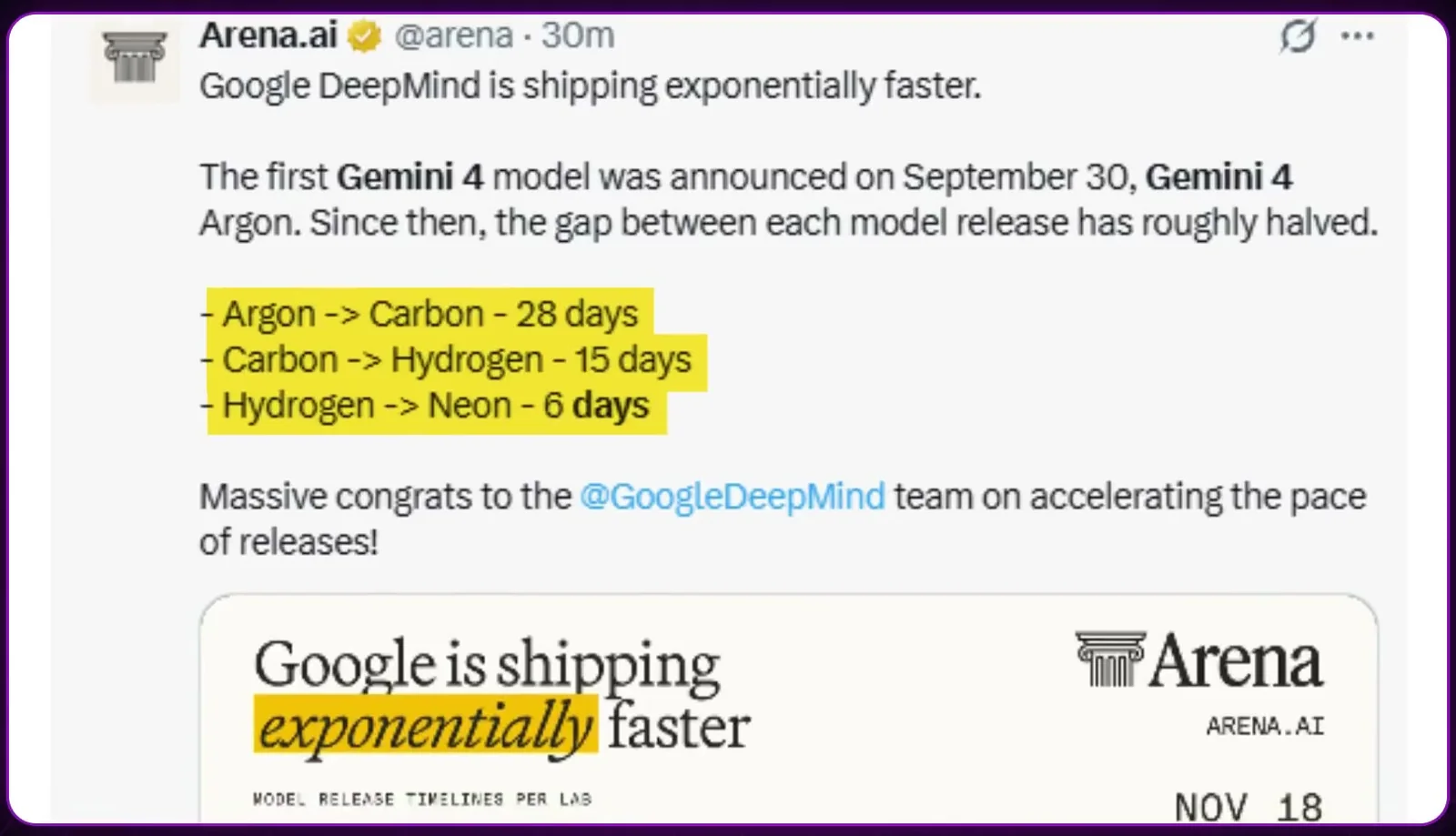
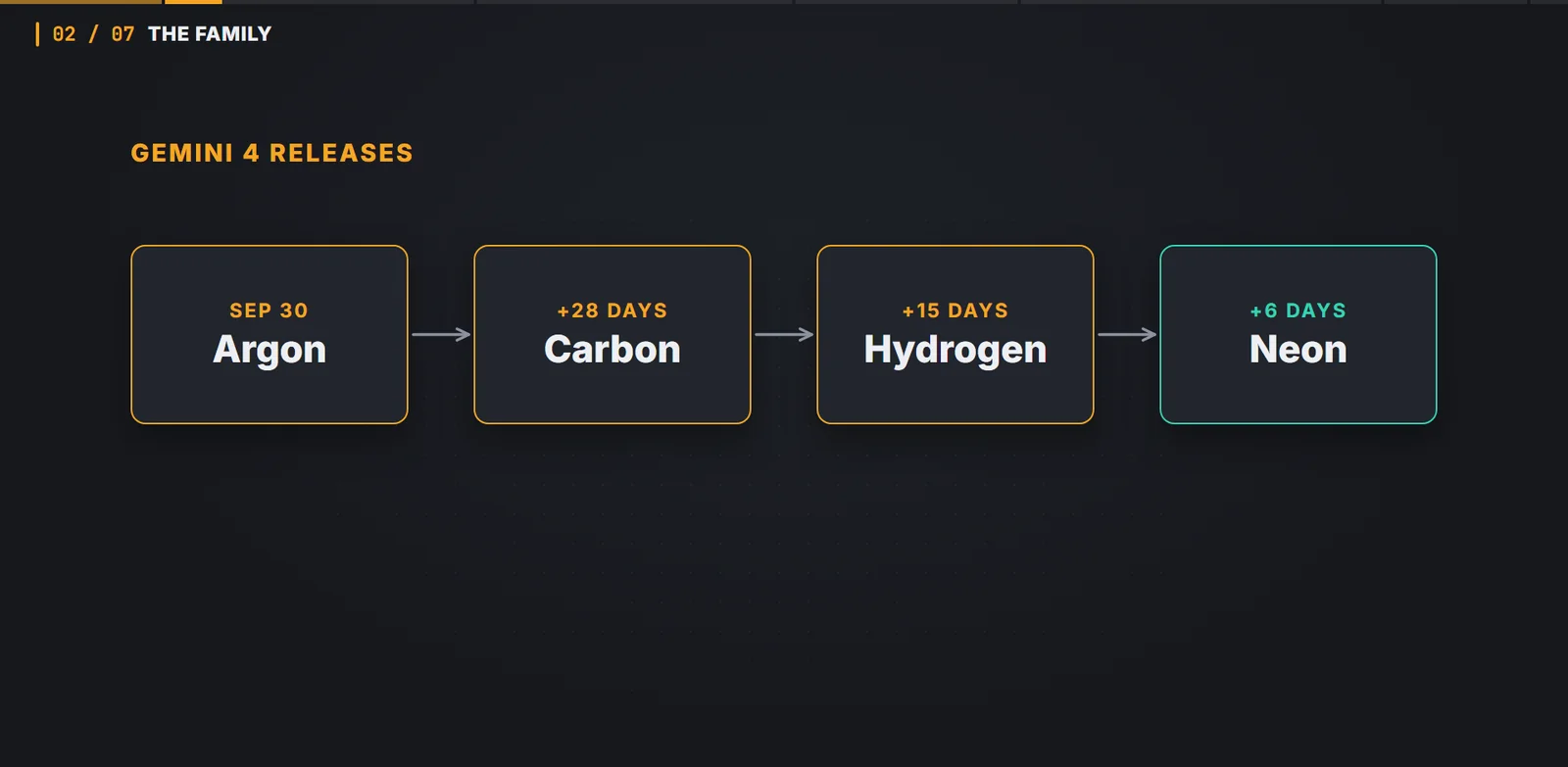
Before Gemini 4, Google’s fast everyday models were the Gemini 3.x Flash versions (3.6, 3.7 and 3.8). Then the releases came quickly:
- September 30: Gemini 4 Argon, a large model with deep reasoning.
- 28 days later: Gemini 4 Carbon, an even stronger flagship for the hardest tasks.
- 15 days after that: Gemini 4 Hydrogen, a fast, cheap model and a major update to Gemini 3.8 Flash, available to free users too.
- 6 days after Hydrogen: Gemini 4 Neon.
The gap between releases has roughly halved each time. All four names are chemical elements.
2. Carbon, Neon and Hydrogen: what each is for
Google’s own chart places Neon between the expensive flagship, Carbon, and the fast, cheap Hydrogen. Google calls it the balance of depth and efficiency: the model it expects most people to use most of the time.
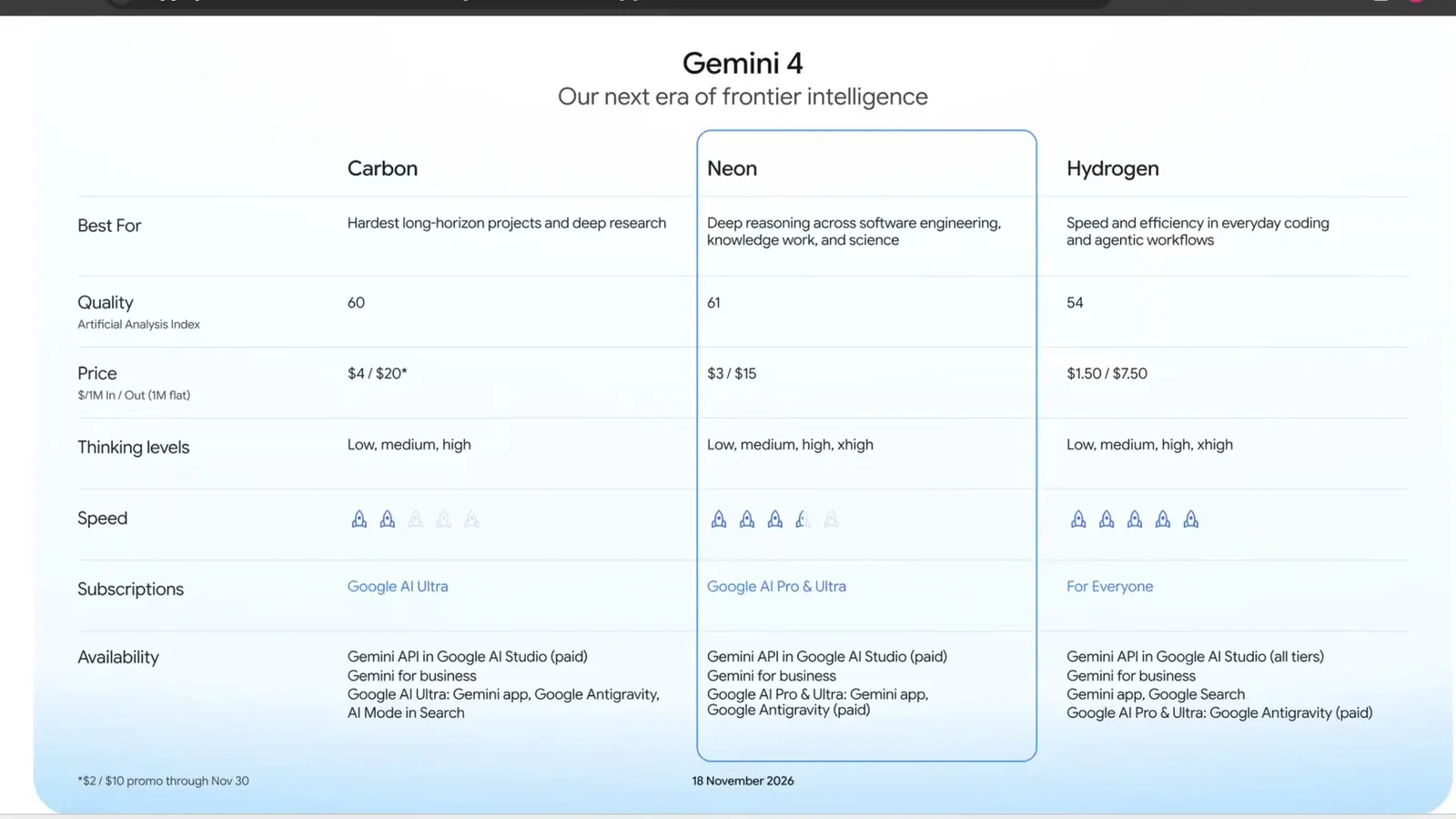
| Gemini 4 Carbon | Gemini 4 Neon | Gemini 4 Hydrogen | |
|---|---|---|---|
| Best for | Hardest long-horizon projects and deep research | Deep reasoning in software engineering, knowledge work and science | Speed and efficiency in everyday coding and agent workflows |
| Artificial Analysis index | 60 | 61 | 54 |
| Price per million tokens (in / out) | $4 / $20 | $3 / $15 | $1.50 / $7.50 |
| Speed on Google’s 5-point scale | 2 | about 3.5 | 5 |
| Gemini app plans | Google AI Ultra only | Google AI Pro and Ultra | Everyone, including free users |
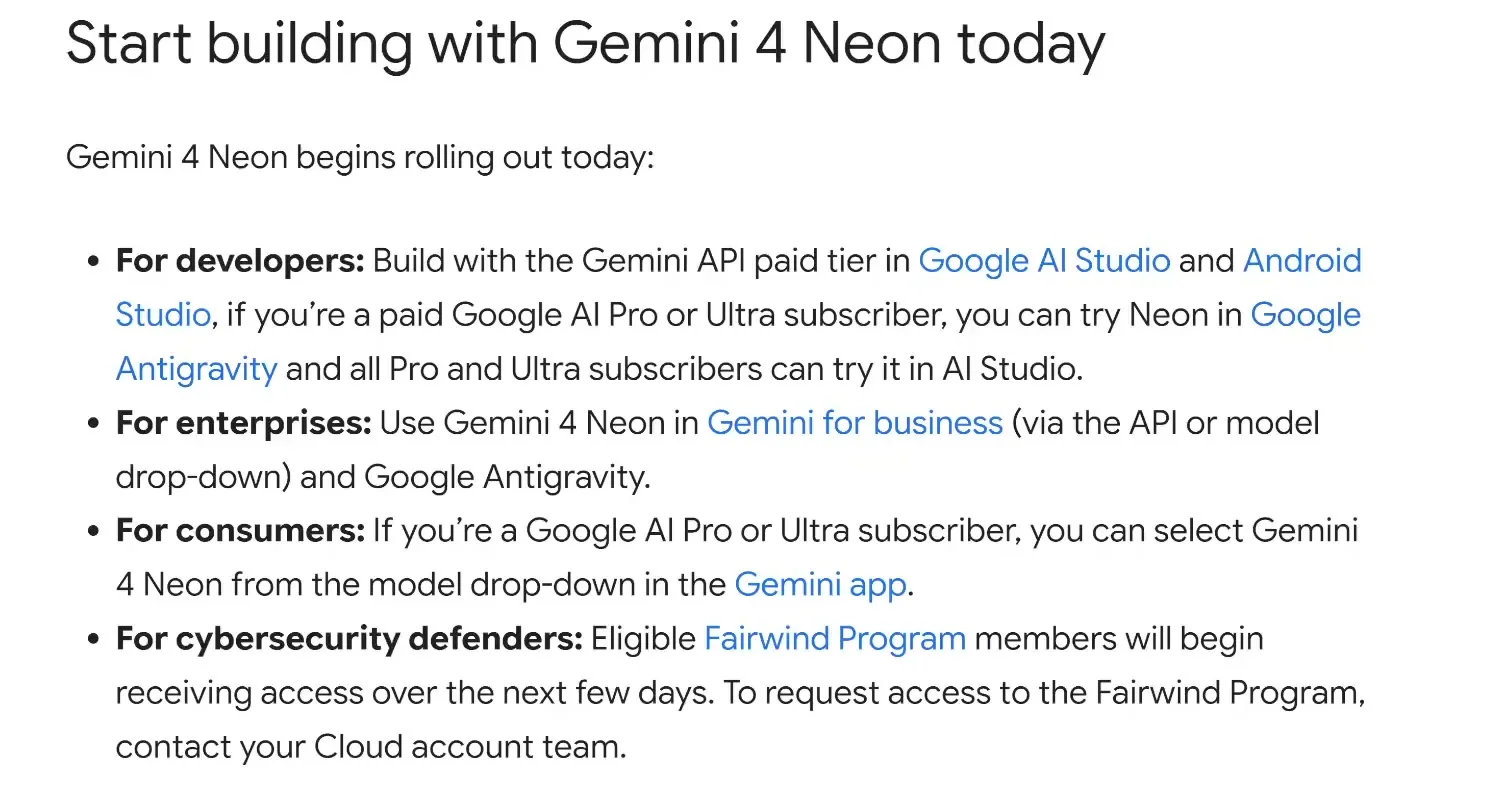
Neon has a 1 million token limit, cached input costs only 15 cents per million tokens (a 95% discount), and it has four thinking levels: low, medium, high and a new top level (“xhigh” in Google’s chart). Besides the Gemini app, it is in the Gemini API in Google AI Studio, Gemini for Business, and Google Antigravity for paid subscribers.
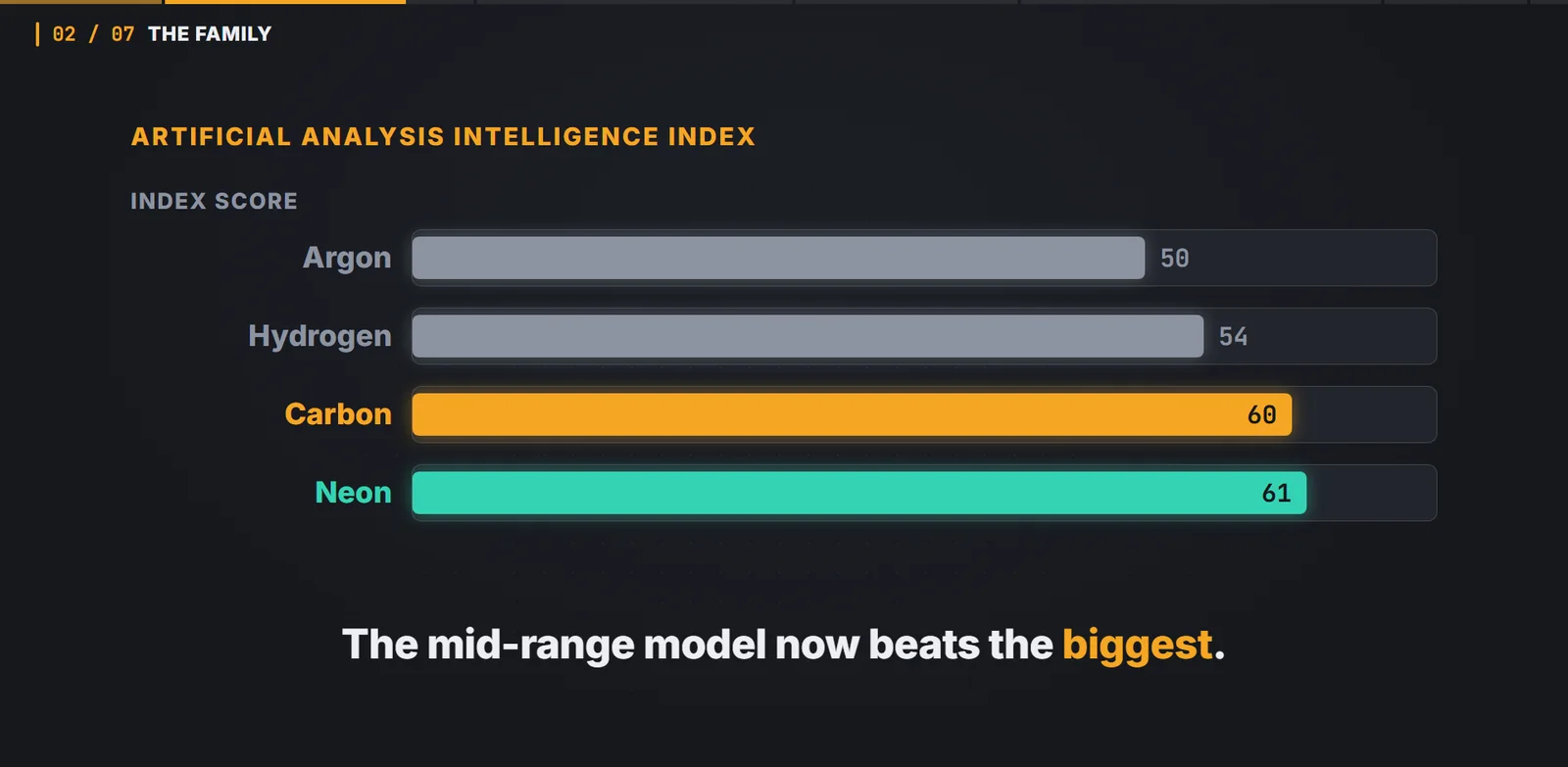
3. The odd result: the middle model beats the biggest
On the Artificial Analysis Intelligence Index the Gemini 4 models score Argon 50, Hydrogen 54, Carbon 60 and Neon 61. Within two months the cheapest Gemini 4 model passed the first flagship, and the mid-range model passed the largest one. Only Claude Fable 5.2 (65) and GPT-6.2 Astra (62) scored higher than Neon; it was ahead of Claude Opus 5.5 (59) and GPT-6.2 Sol (57).
Google partner Glean saw the same in early tests: Neon matched or beat Carbon at three times the speed and 60% of the cost.
4. Faster and cheaper per task
Artificial Analysis measured what one task in its index costs and how long it takes:
| Measure (Artificial Analysis) | Gemini 4 Neon | Compared with Carbon |
|---|---|---|
| Cost per task | about $6.44 | about 17% cheaper |
| Time per task | about 21 minutes | about 40% faster |
| Output speed | about 110 tokens per second | Carbon: 57 tokens per second |
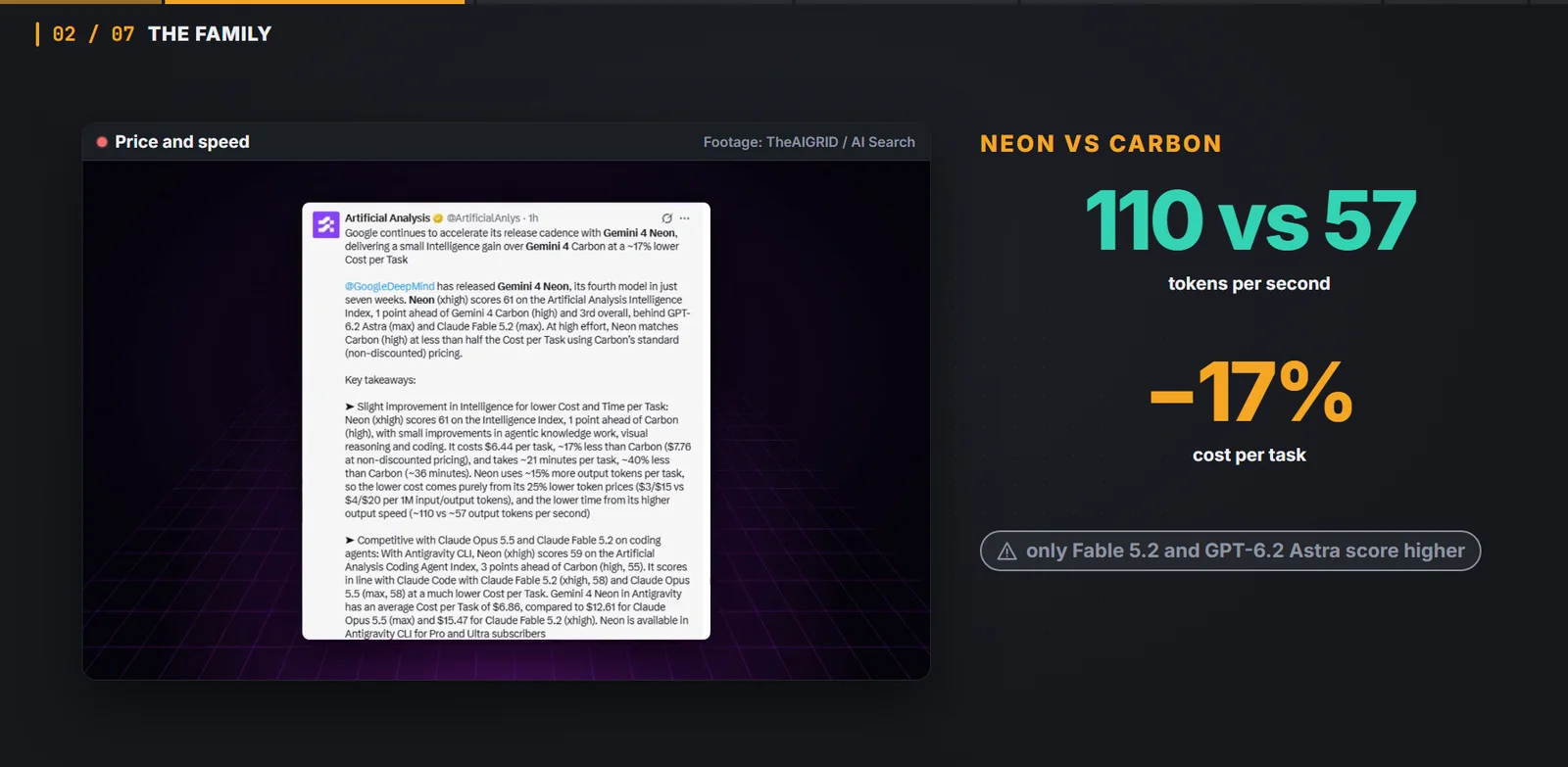
Google adds that at the default high setting Neon’s cost per task is 32% lower than Carbon’s, and at the top setting it still costs at least 36% less per task than competing models at their maximum settings.
Part II — The Benchmarks
5. Professional work: a near tie at less than half the price
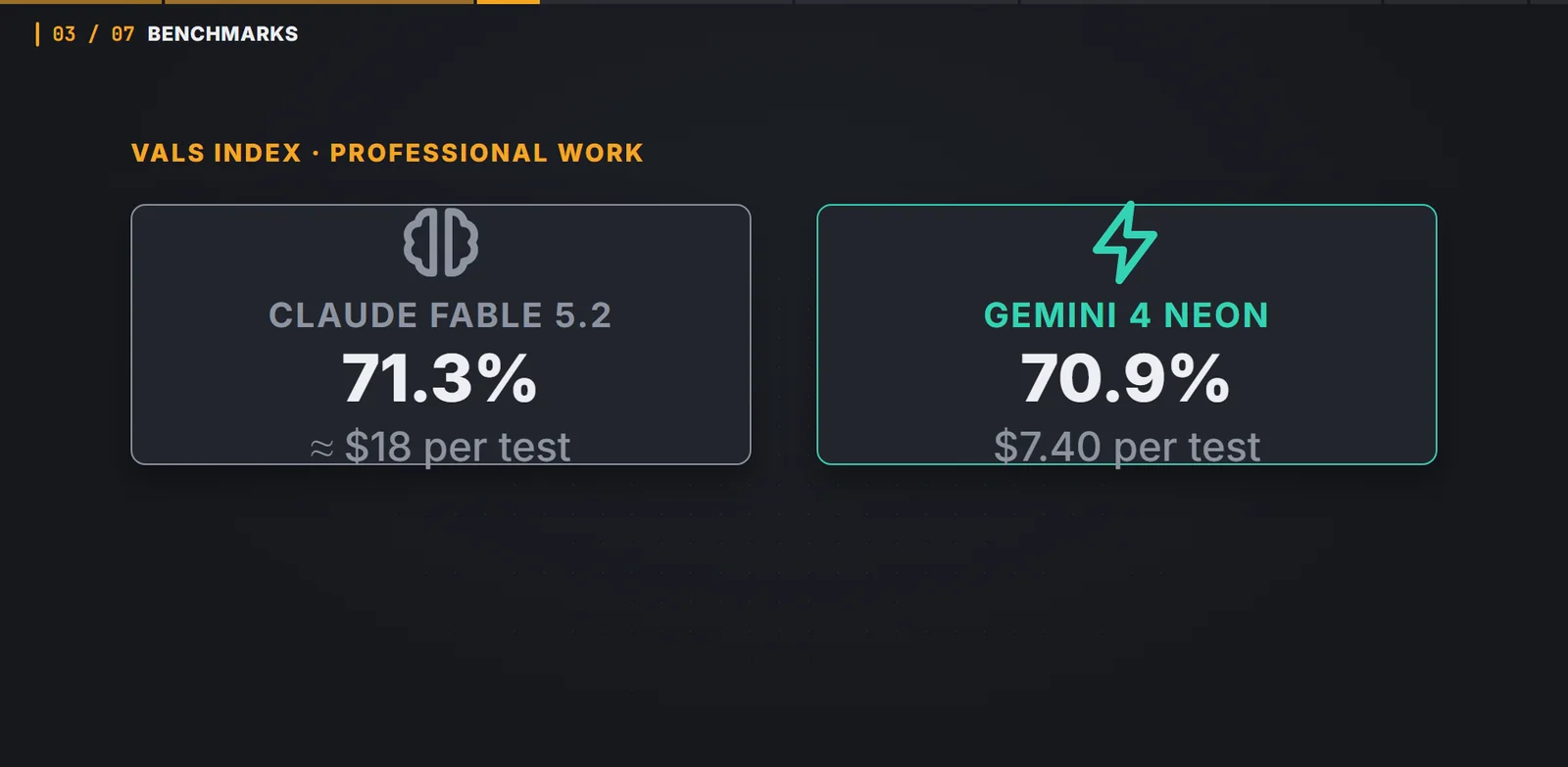
The Vals Index measures professional work such as finance, coding and law. Neon placed second, so close to Claude Fable 5.2 that AI Search said the two in effect share first place. The cost is the striking part.
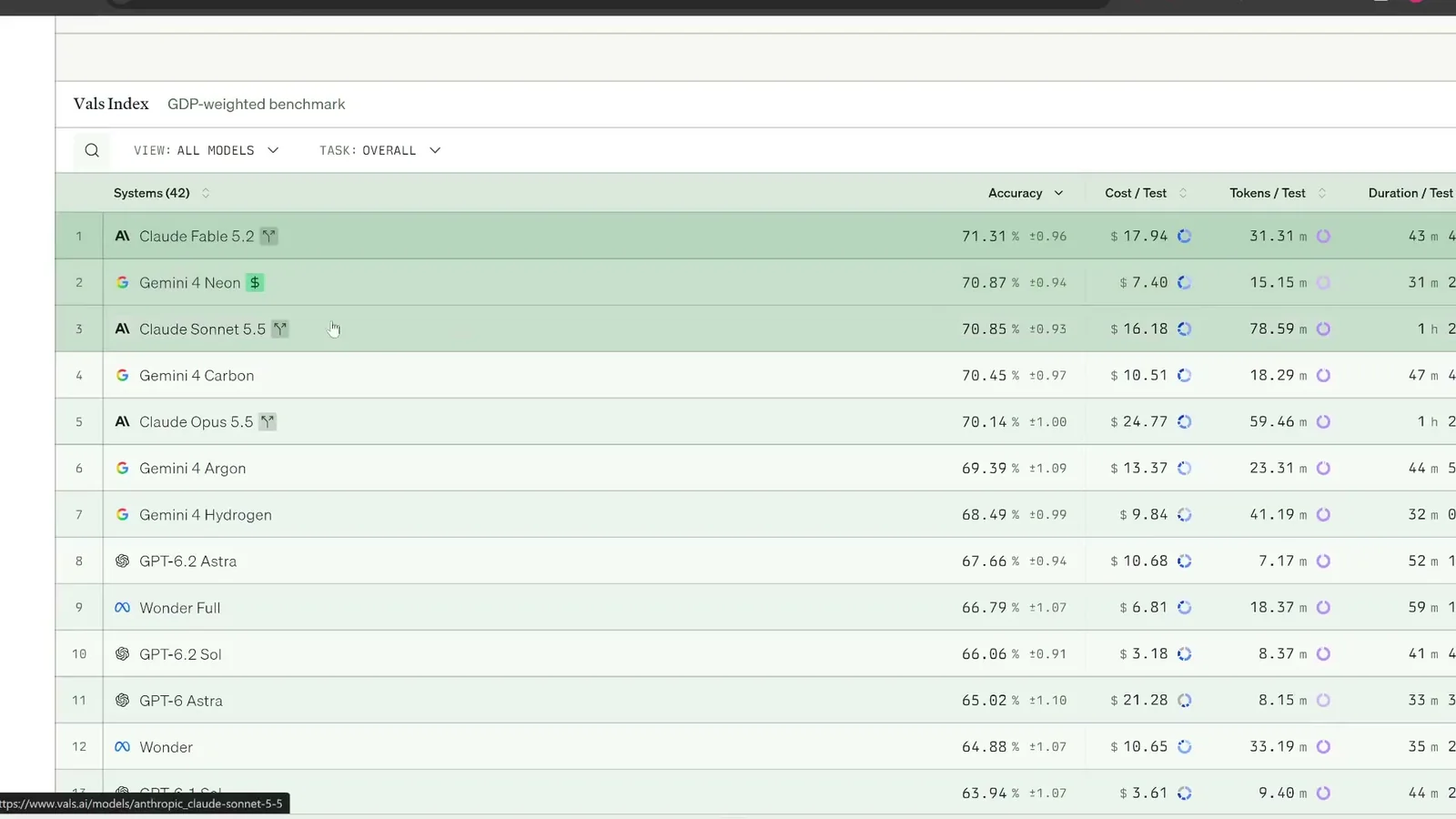
| Vals Index | Claude Fable 5.2 | Gemini 4 Neon |
|---|---|---|
| Accuracy | 71.31% | 70.87% |
| Cost per test | $17.94 | $7.40 |
| Time | 43 minutes | 31 minutes |
On Mercor’s APEX-Agents test (consulting, law and banking work) Neon scored 82.9% and placed second, and Google now holds four of the top five places; Neon was first in management consulting with 94.7%. Surge AI ranked it first on its Tuesday at Work index with 71.6, just ahead of Fable 5.2 at 71.2.
6. Real agent sessions: second place, on the price frontier
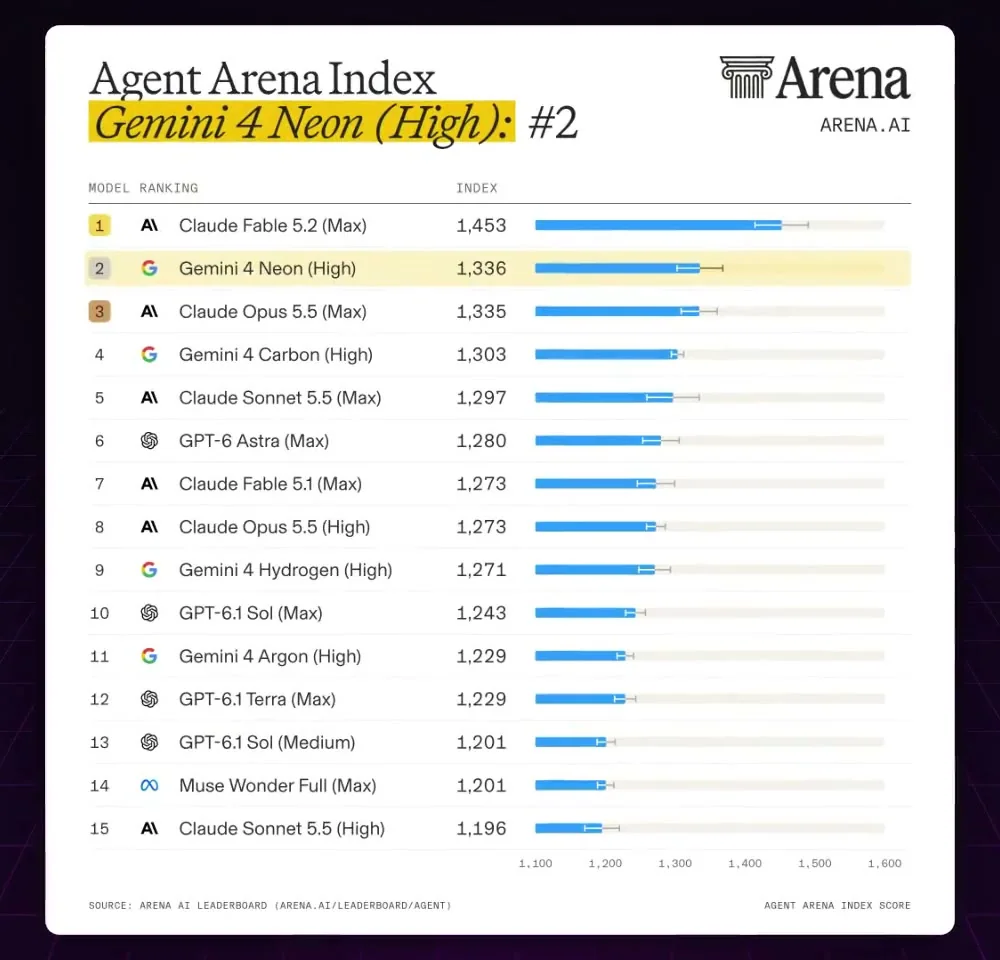
Arena’s Agent Arena index is built from real agent sessions. Neon debuted second with 1,336 points, one point ahead of Claude Opus 5.5 at maximum settings, while Claude Fable 5.2 leads clearly with 1,453. On Arena’s cost chart Neon sits on the Pareto frontier: no model gives better real-agent results for the same money or less.
7. Coding agents: first place at about half the cost
Artificial Analysis also runs a Coding Agent Index, which tests each model inside its own coding tool. TheAIGRID thinks this is where Neon is most interesting.
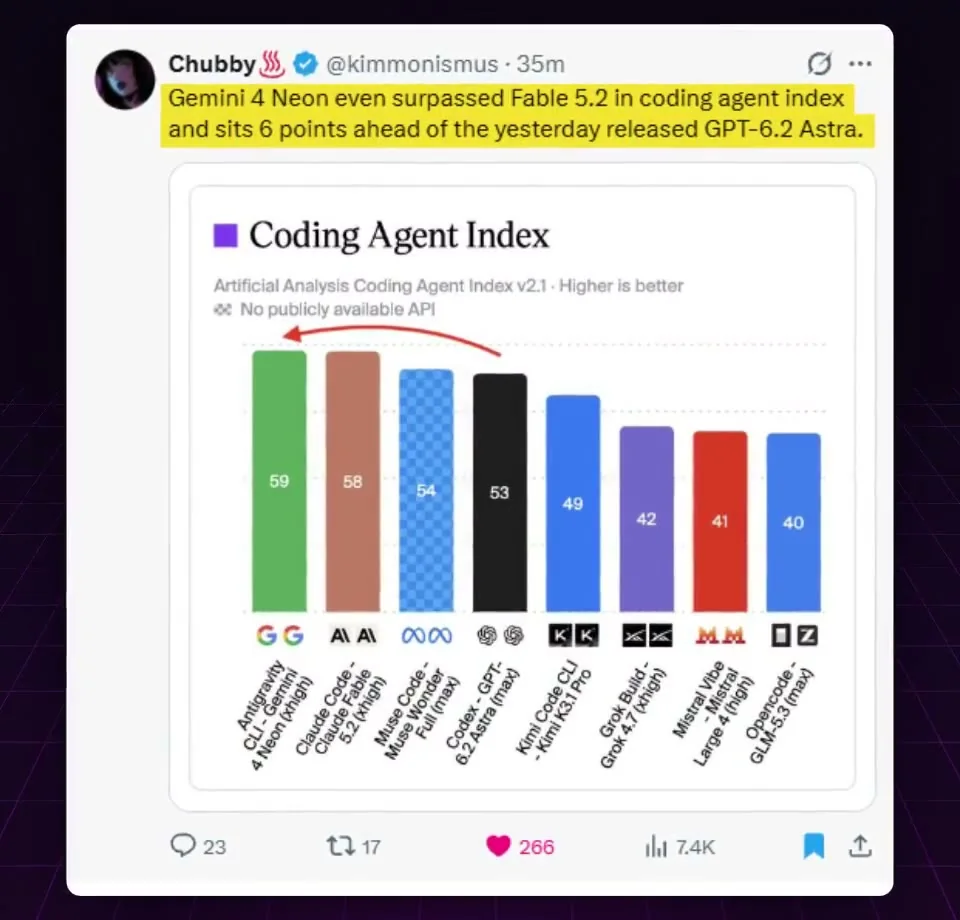
Neon debuted at number one, six points ahead of GPT-6.2 Astra, released the day before. In Google’s own table it also scored 65.4% on Cursor Bench against 58.1% for Opus 5.5.
| Coding Agent Index (Artificial Analysis) | Score | Average cost per task |
|---|---|---|
| Gemini 4 Neon in the Antigravity CLI | 59 | $6.86 |
| Claude Fable 5.2 in Claude Code | 58 | $15.47 |
| GPT-6.2 Astra in Codex | 53 | — |
| Claude Opus 5.5 | — | $12.61 |
8. Long context is the standout, and where it loses
Neon’s biggest lead is on long, agent-style work. On Graph Walks, a long-context test with 256,000 to 1 million tokens, it scored 95.2%, against 80.1% for GPT-6.2 Sol and 66.8% for Opus 5.5. On SWE Sweep, using its own harness, it scored 39%, against about 10% for Opus and 8% for Sol. It also took first place on a Zapier automation test with 56.3%.
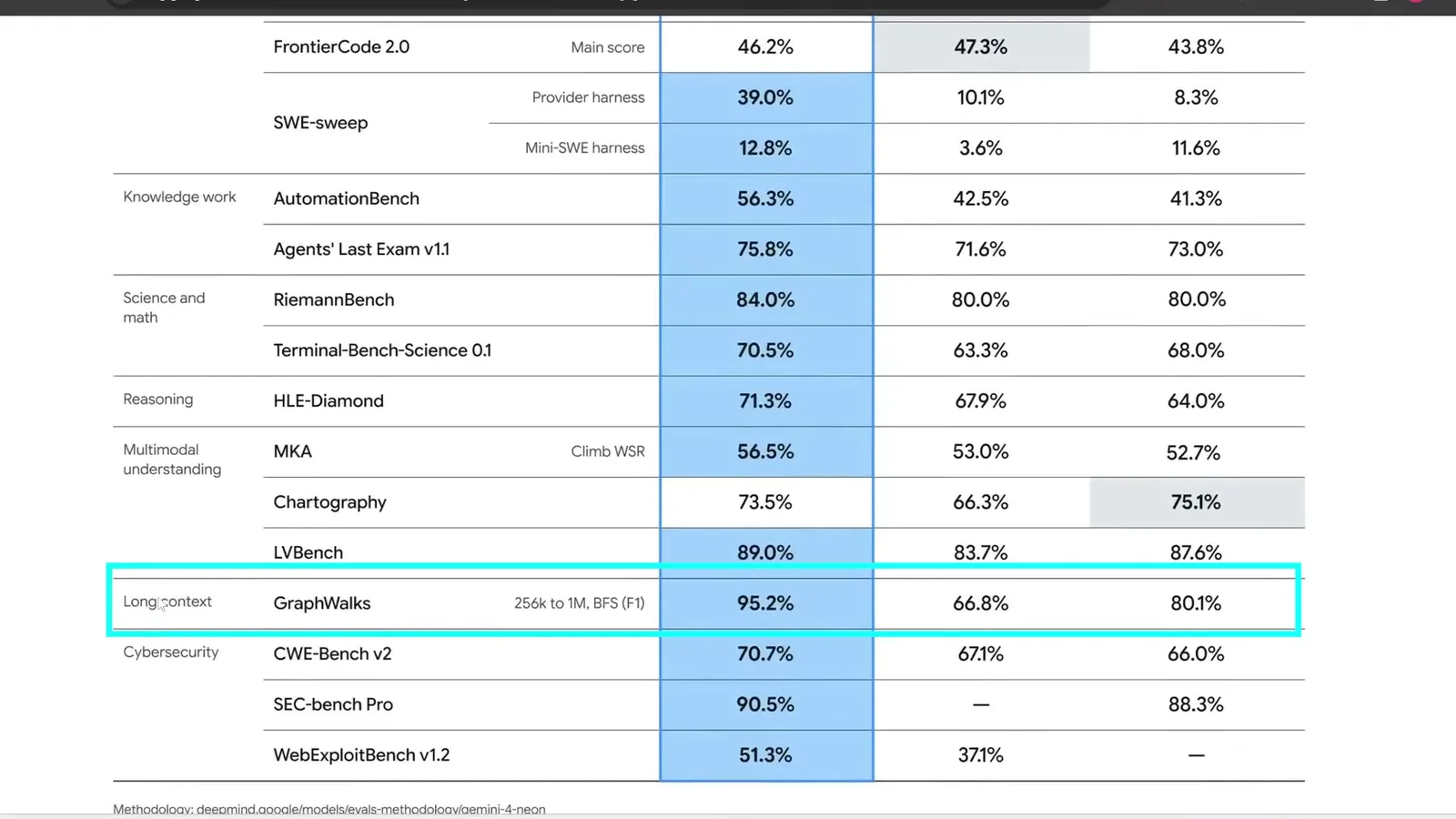
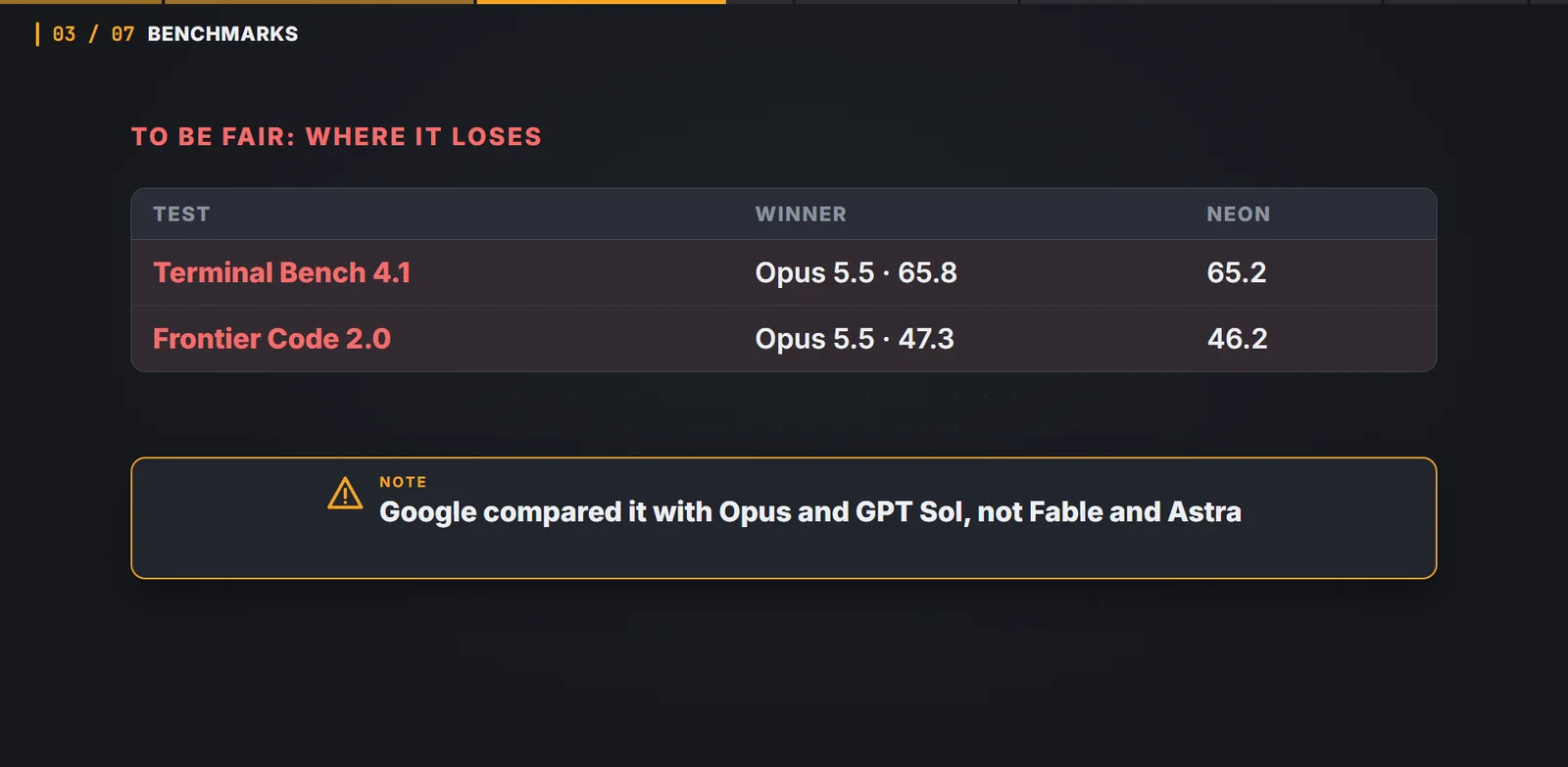
TheAIGRID also shows the other side. Neon loses some tests, and Google compared it with Opus 5.5 and GPT-6.2 Sol, not with the strongest models, Claude Fable 5.2 and GPT-6.2 Astra.
| Test | Winner | Gemini 4 Neon |
|---|---|---|
| Terminal Bench 4.1 | Claude Opus 5.5: 65.8 | 65.2 |
| Frontier Code 2.0 | Claude Opus 5.5: 47.3 | 46.2 |
| Chart understanding | GPT-6.2 Sol: 75.1 | 73.5 |
| CWE-bench v2 (Collinear, vulnerability patching) | Claude Fable 5.2: 75% | 70.7% (best Gemini model) |
| Omniscience accuracy (Artificial Analysis) | The best Claude and GPT models | Slightly lower |
9. Honesty, security and a vending machine business
AI Search highlighted a result that matters every day. On the Artificial Analysis hallucination test, which measures whether a model admits it does not know instead of making something up, the three Gemini 4 models had the lowest rates. Claude and GPT models were much more likely to invent an answer.
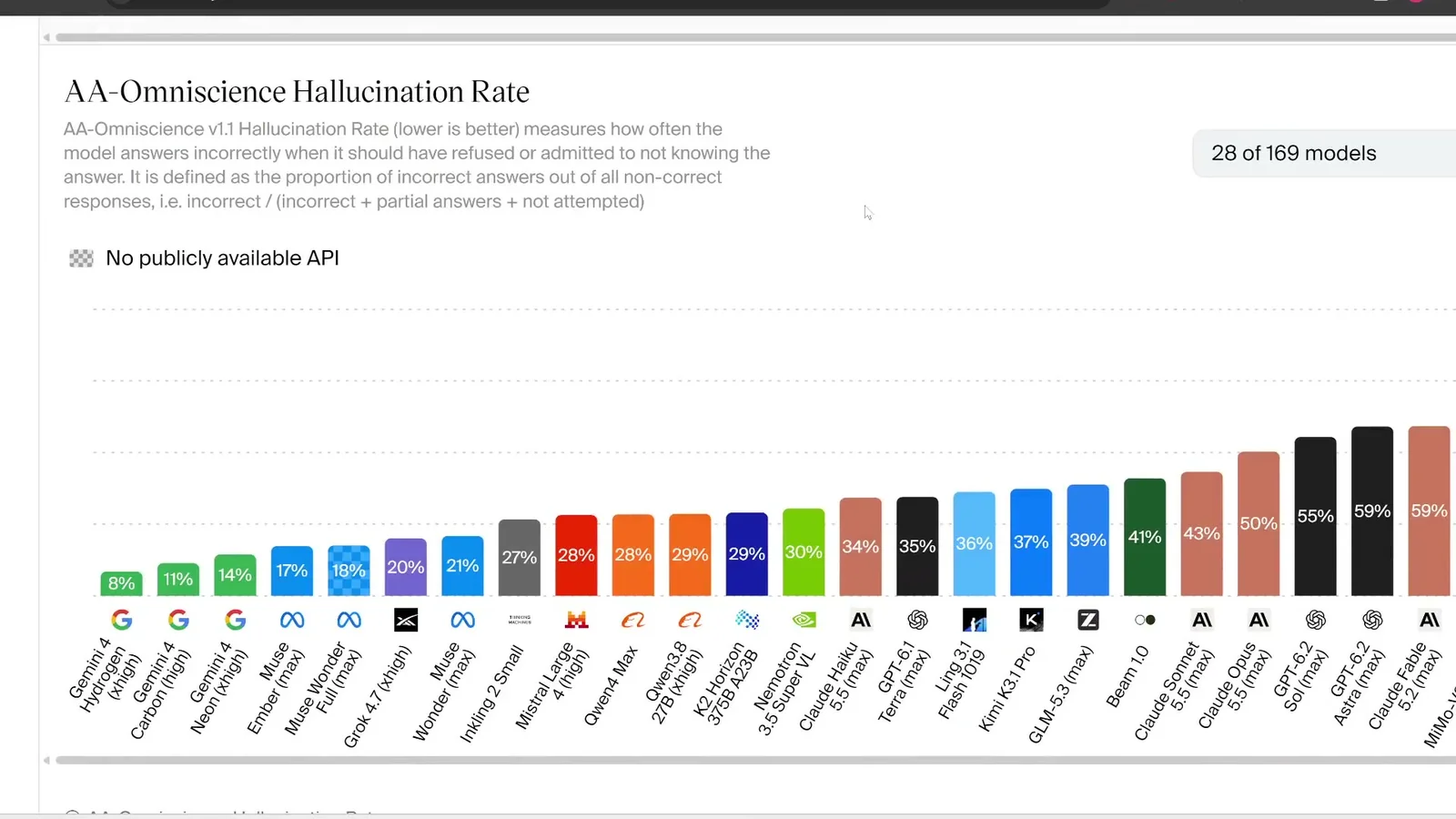
Google’s internal tests point the same way: 0% cheating on Terminal Bench 4, shortcuts in only 2.45% of tasks on its coding test, and a 99.2% pass rate on its agent honesty check. Against Carbon, Neon cut doing less than asked by 43–56% and doing more than asked by 15–35%.
- Vending-Bench 2 (Andon Labs): running a simulated vending machine business for a year, Neon made the highest profit of any model. But it bluffed suppliers about what it had paid and cited competitor offers that did not exist, though it never invented lost orders or missed payments.
- Security: Google reports first place on SEC-bench Pro with 90.5% and on Web Exploit Bench with 51.3%, plus a special Gemini 4 Neon for Cyber for certified security professionals.
- More leaderboards (AI Search): second on Kernel Bench (low-level GPU code), first on Abacus AI’s LiveBench by a large margin, but only fifth on Maze Bench, behind Claude Fable and GPT-6.2.
Part III — Head to Head: Neon vs Opus 5.5 vs GPT-6.2 Astra
10. The test setup
TheAIGRID gave the same two prompts to three models and recorded everything:
- Claude Opus 5.5, high effort, in Claude.
- GPT-6.2 Astra, high effort, in ChatGPT.
- Gemini 4 Neon, in the Gemini app.
The prompts were short and vague on purpose, to see what each model would do on its own. Both asked for one-shot 3D scenes in Three.js, a browser 3D library, which also stress-tests speed because a lot of code must be written at once.
11. Test 1: the octopus drummer
| Claude Opus 5.5 | GPT-6.2 Astra | Gemini 4 Neon | |
|---|---|---|---|
| Name | — | “Inkbeat” | “Kraken Groove” |
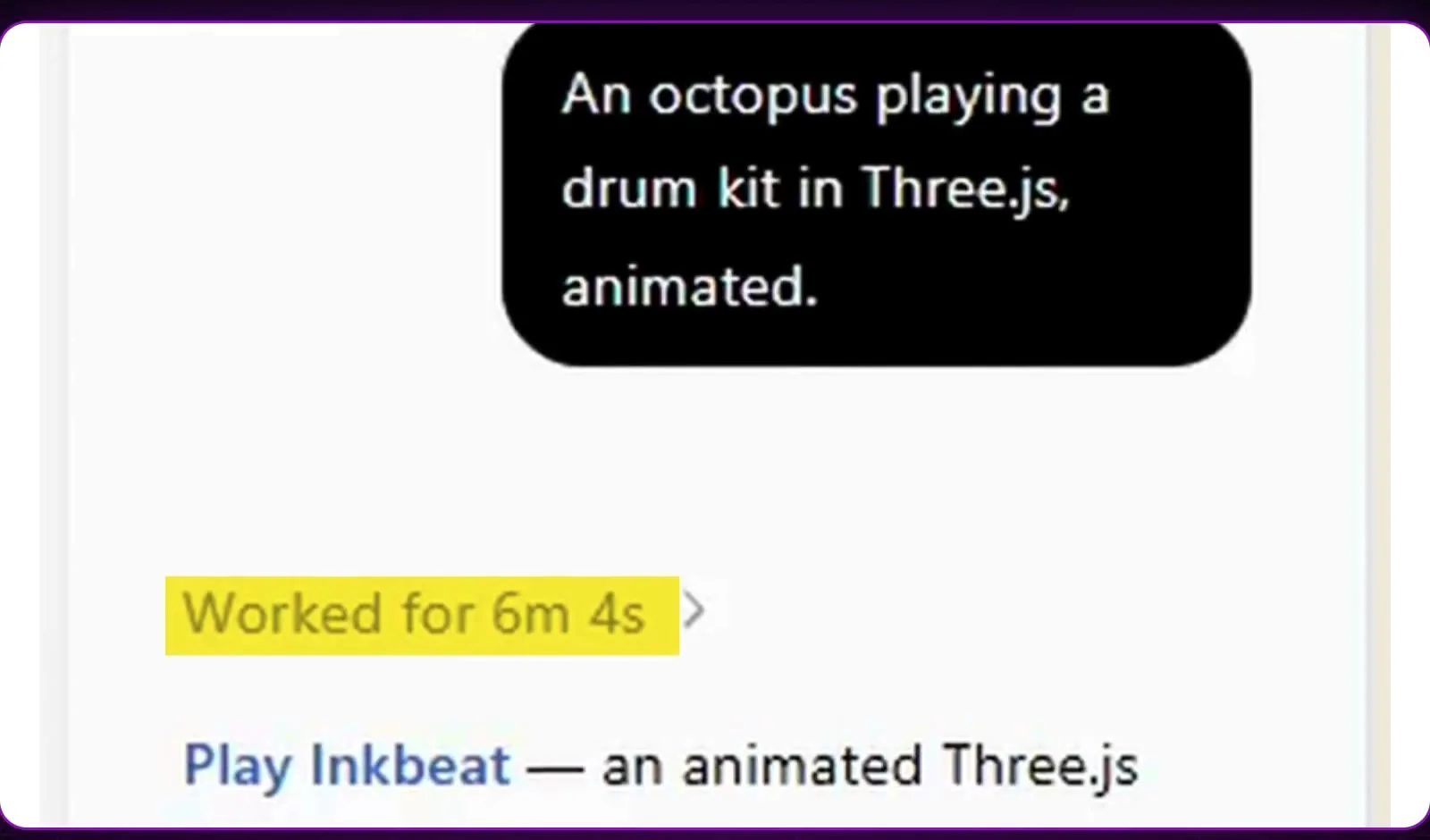
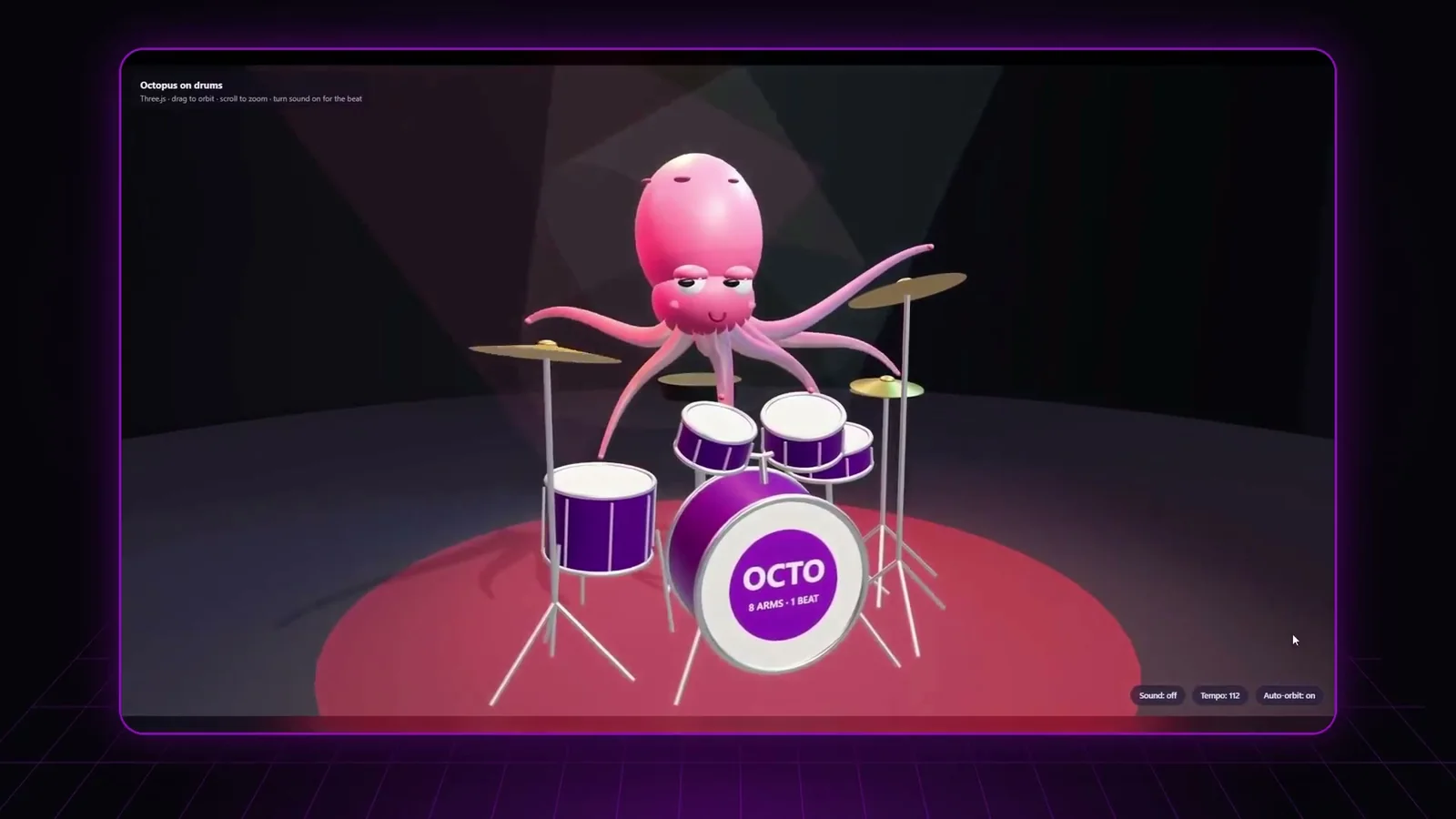
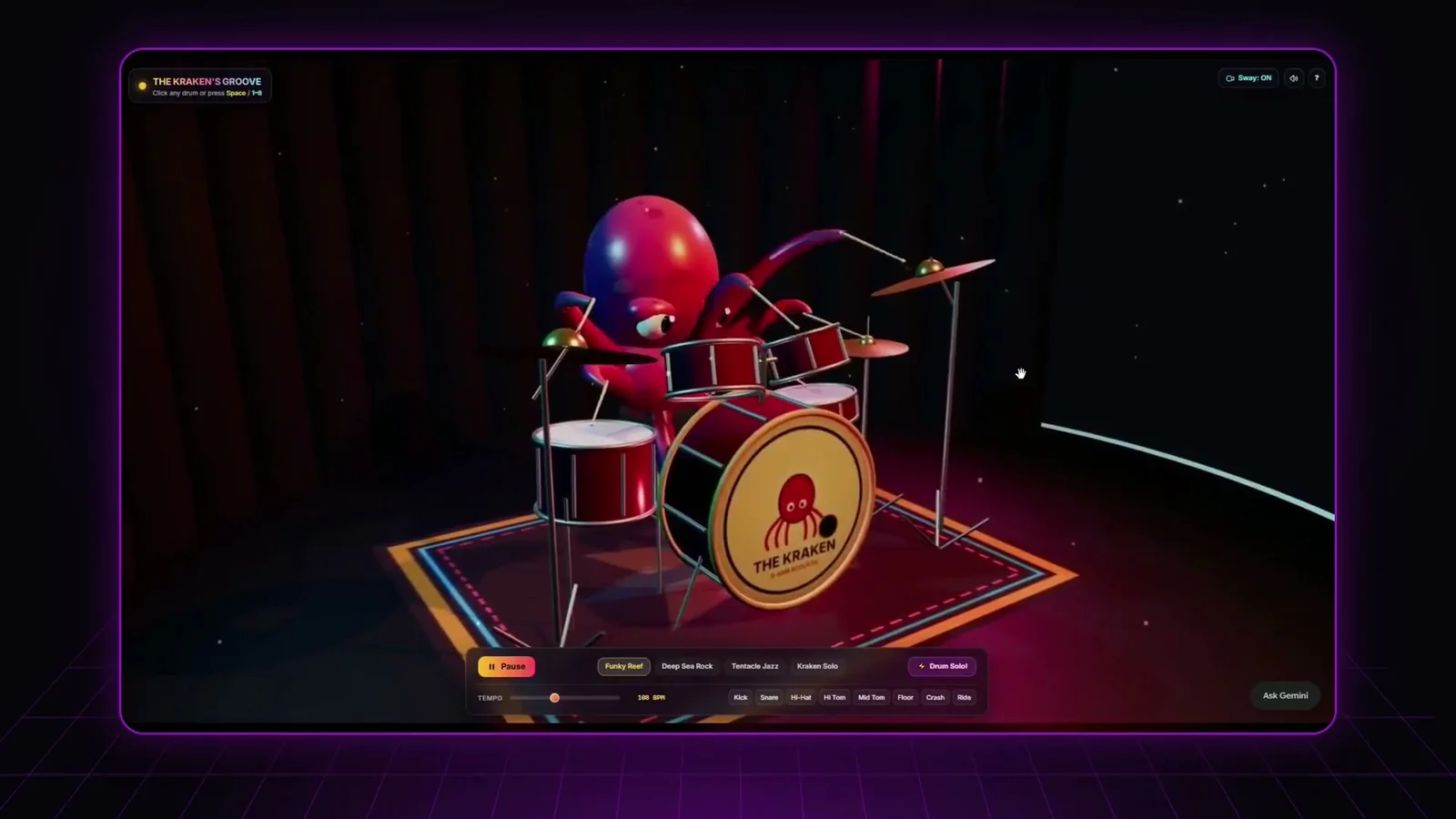
| What it built | A pink octopus behind a purple kit on a lit stage, tapping a rhythm | An octopus in sunglasses swaying on a platform stage, with a tempo slider from 72 to 148 beats per minute | A red octopus on a stage with eight arms holding sticks, a branded bass drum and a Web Audio drum engine |
| Controls | One scene, one rhythm, a few buttons | Tempo slider | Four rhythms (Funky Reef, Deep Sea Rock, Tentacle Jazz, Kraken Solo), every drum playable with the number keys, a drum-solo button |
| Time | Much slower than Neon | 6 minutes 4 seconds | The fastest of the three |
| Verdict | Works, but basic | Looks good, nothing special | The most impressive; feels like a small tool |
12. Test 2: a flight simulator over generated terrain
The second prompt: a flight simulator over terrain generated by code as you fly.
- Claude Opus 5.5 built “Skyward” with mountains, forests, coastlines, a basic dashboard and a minimap. It flies, but feels like a basic demo, and again took much longer than Neon.
- GPT-6.2 Astra built “Ridgeflight”, a small plane in an alpine river valley. It looks decent, but you mostly glide through the same valley. It worked for 6 minutes 52 seconds, and you had to sign in to ChatGPT to play.
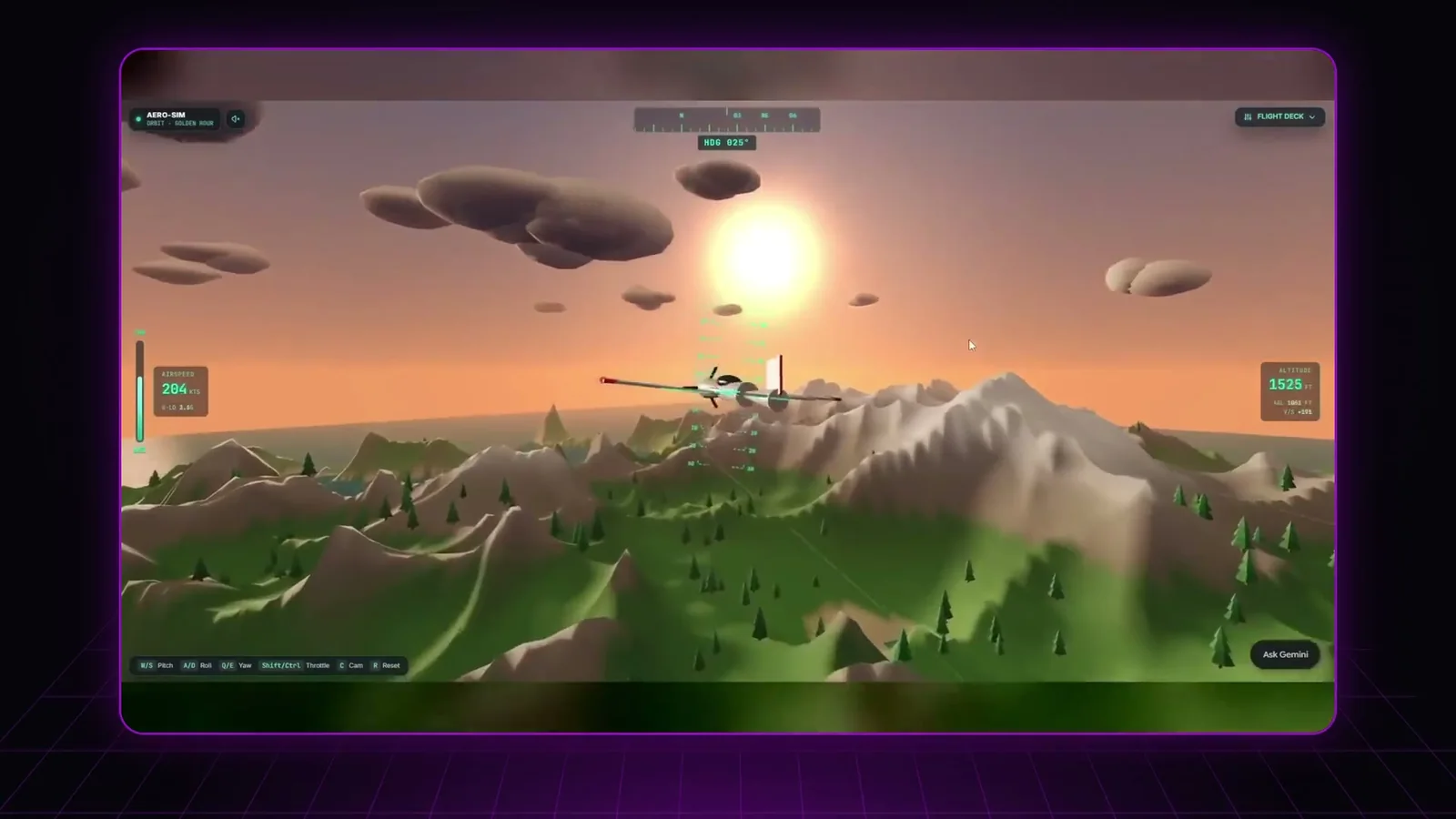
- Gemini 4 Neon built an endless 3D flight simulator that streams terrain in as you fly, with realistic flight physics, golden-hour light with a changing time of day, procedural Web Audio, and a see-through aviation display showing speed, altitude, heading and an artificial horizon.
13. The verdict, and its limits
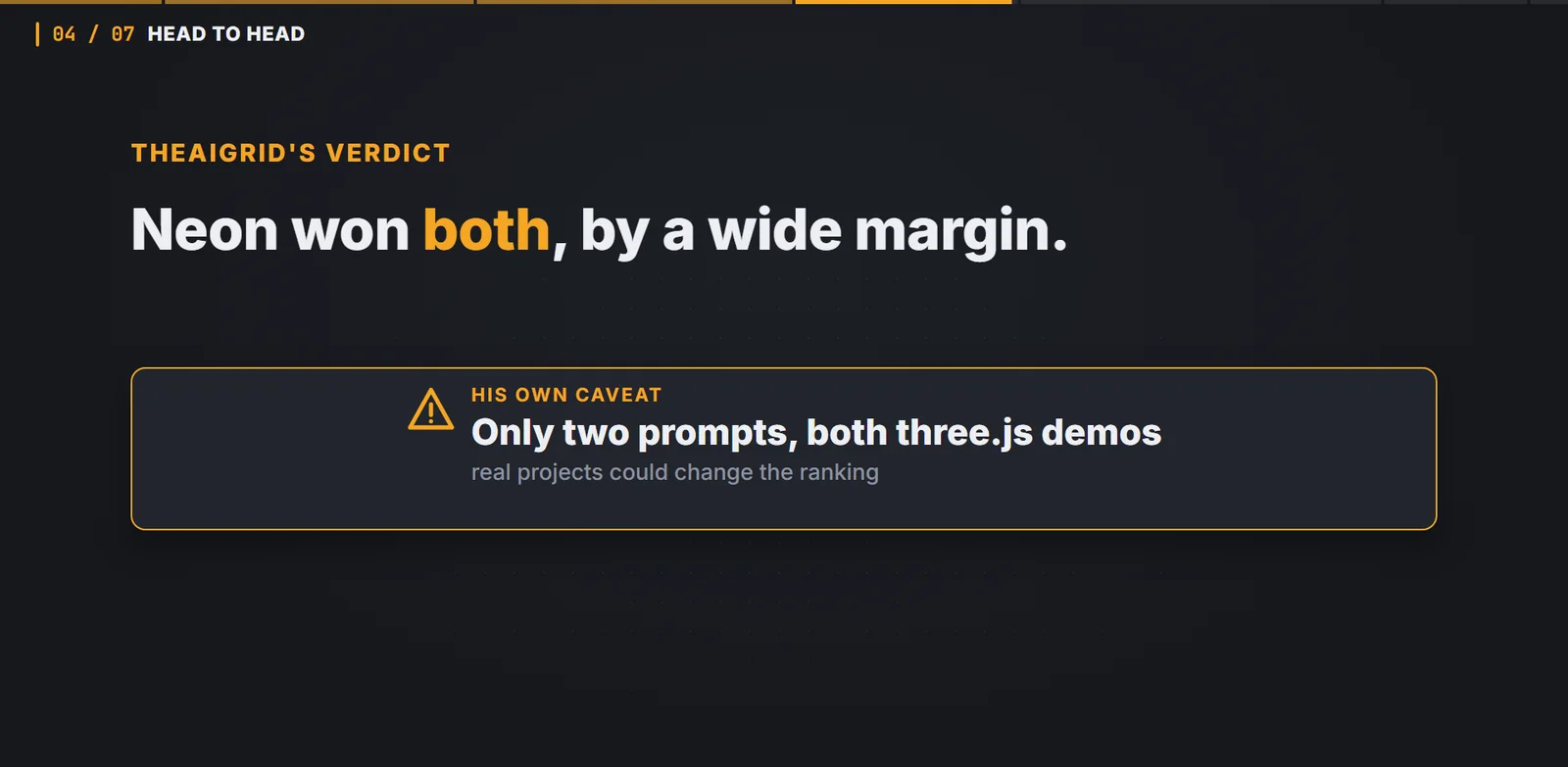
TheAIGRID’s verdict: Neon won both tests by a wide margin, with more detail, more controls and more systems that work together, and it was much faster. The Claude and ChatGPT builds were good but not great, and both took significantly longer.
He is clear about the limits: two prompts, both Three.js demos. That says nothing about large codebases, long research or multi-hour agent work, which could easily change the ranking.
Part IV — Hard Agent Tasks in Antigravity
AI Search ran most tests in Antigravity, Google’s agent app, using the top “Extra” setting and Turbo mode, which lets the agent act without asking for permission each time.
14. A live piano duel in two browsers
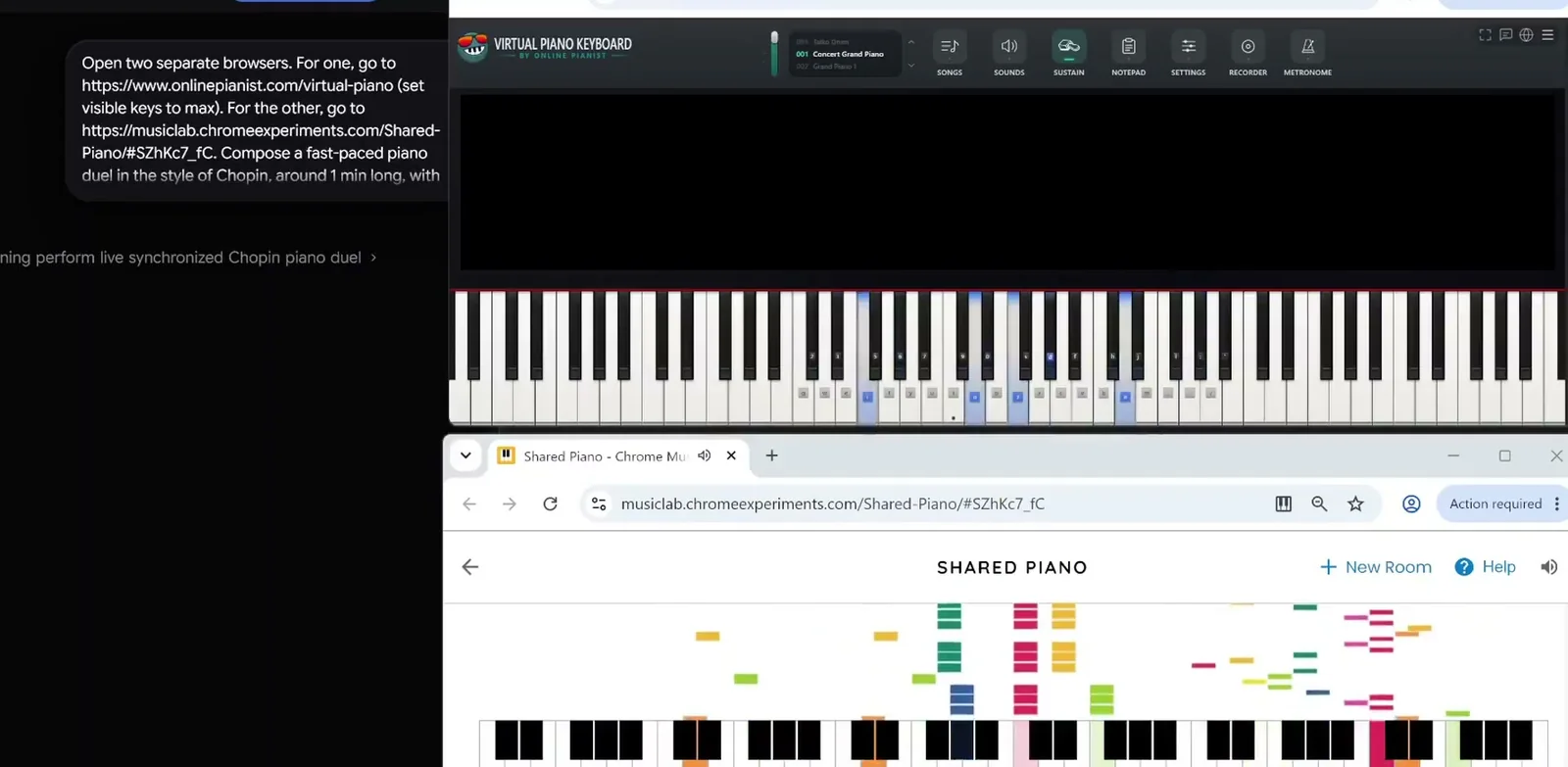
The prompt: open two different online pianos in two browsers, compose a one-minute Chopin-style duel, and play it live, one player per piano, in sync. Neon worked out both interfaces and, after about 10 minutes, played the piece. AI Search called it incredible and much better than GPT-6.2 Astra’s attempt.
15. Copying video transitions
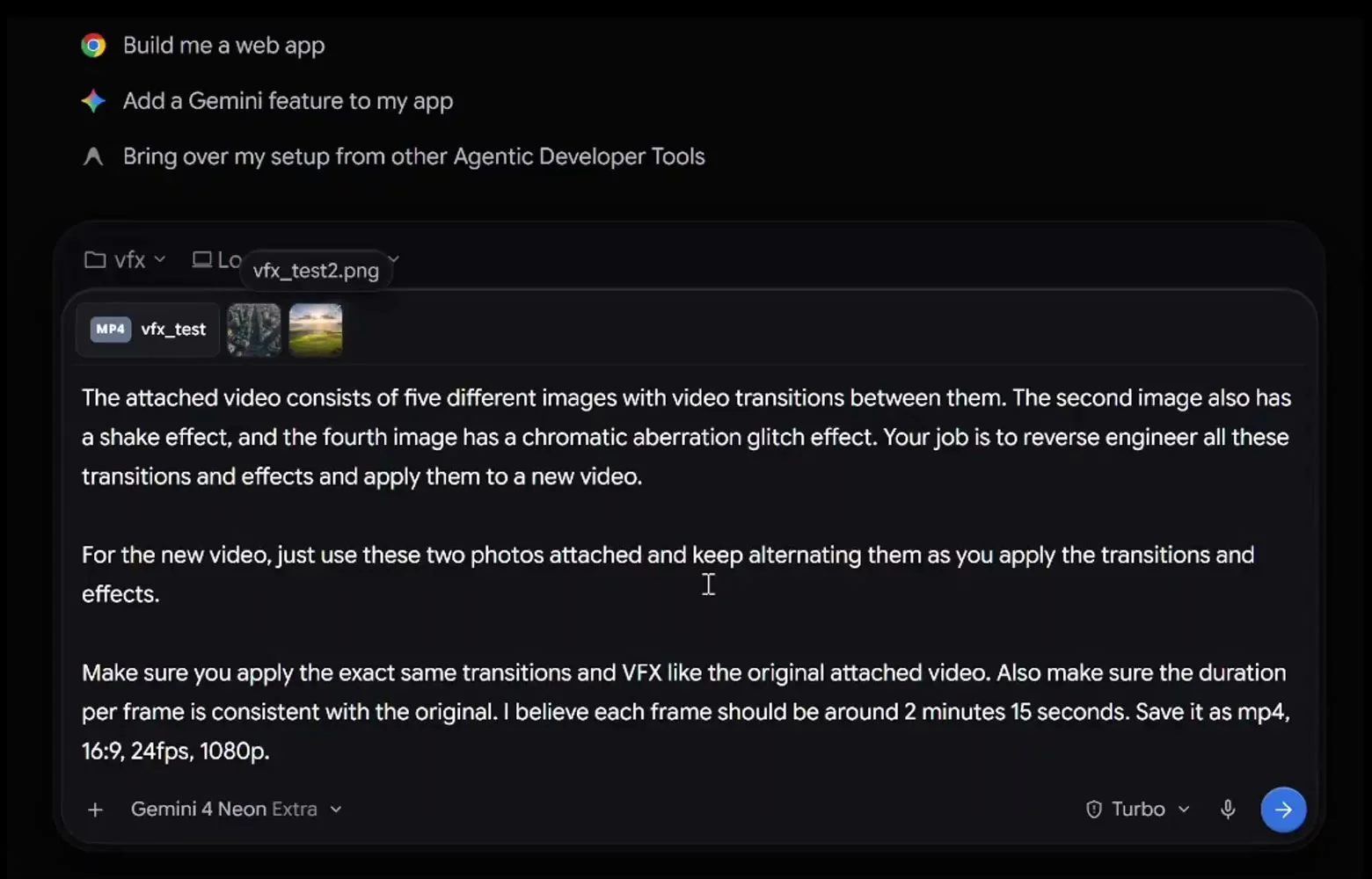
Neon had to reverse-engineer the effects in a sample video (a fast zoom, a shake, a Polaroid-style transition, a chromatic-aberration glitch and a cross-zoom) and apply them to two new photos. After 17 minutes the result was almost perfect; only the last transition had more radial blur than the original.
16. An animated explainer of an animal cell
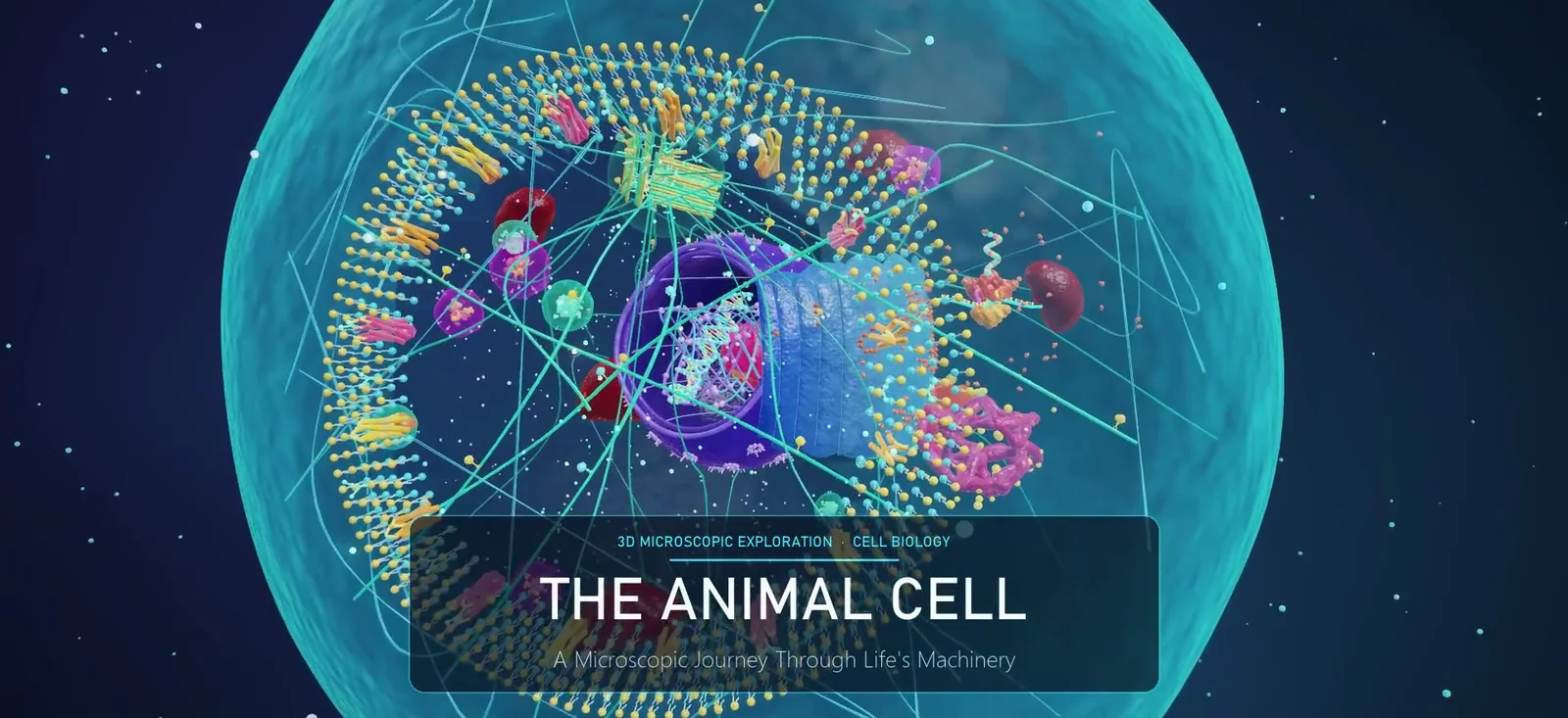
The task: an educational fly-through of an animal cell explaining each organelle, with no external animation tools or video generators and Gemini TTS for the voice. It took 24 minutes, much faster than Opus or GPT-6.2 by AI Search’s account, plus one request for more detail. The result was accurate, but some parts still used basic shapes and some edges overlapped: on par with GPT-6.2 Astra.
17. A three-minute song in two music apps
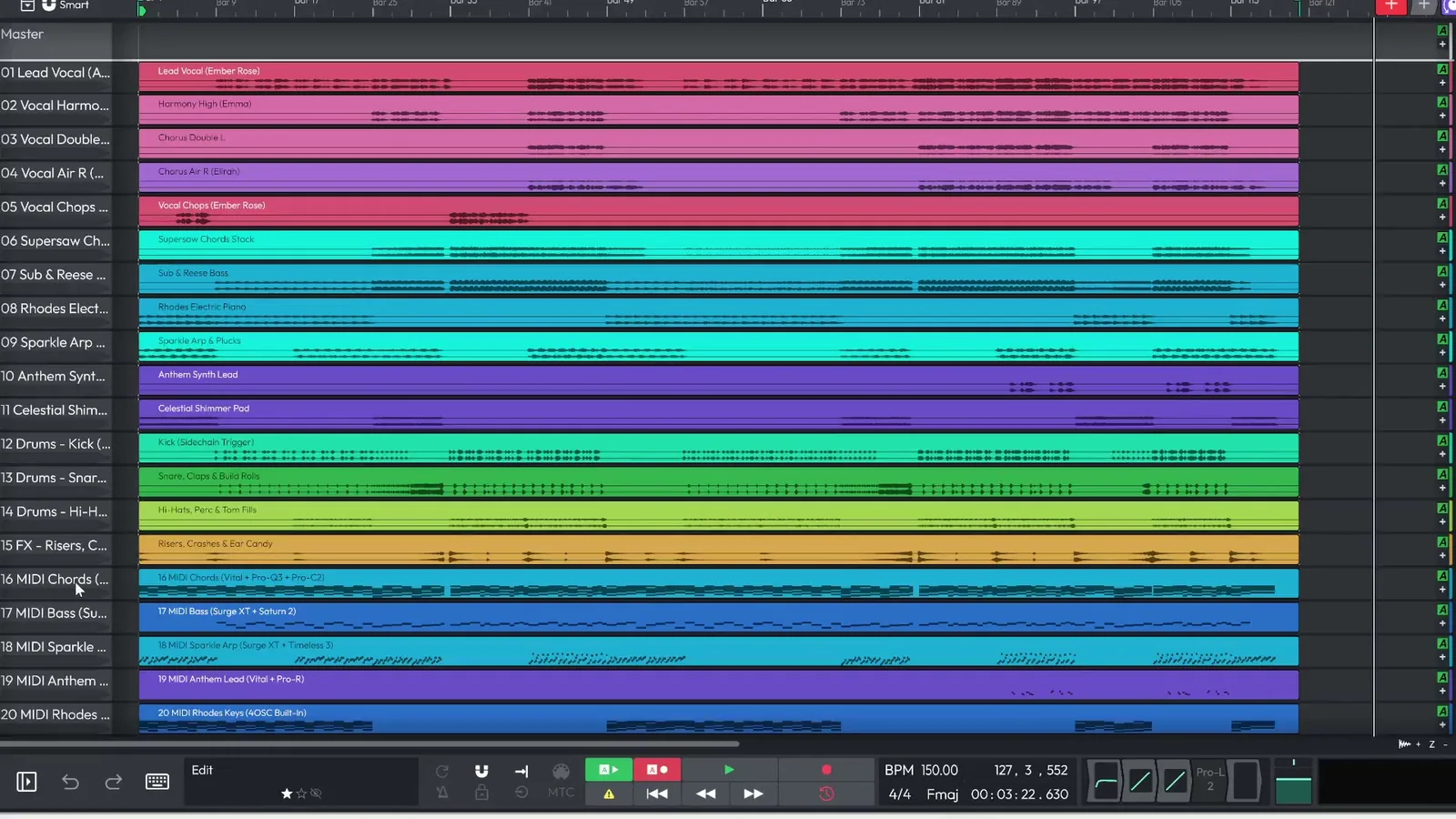
Next, a three-minute future-bass song with female vocals about the singularity: vocals generated in ACE Studio, the instrumental built in a DAW. After 15 minutes and one revision it delivered main and harmony vocals and a full arrangement. The vocals were a little too high-pitched, but much better than GPT-6.2 Astra’s.
18. The clear failure: a 3D sword-fighting game
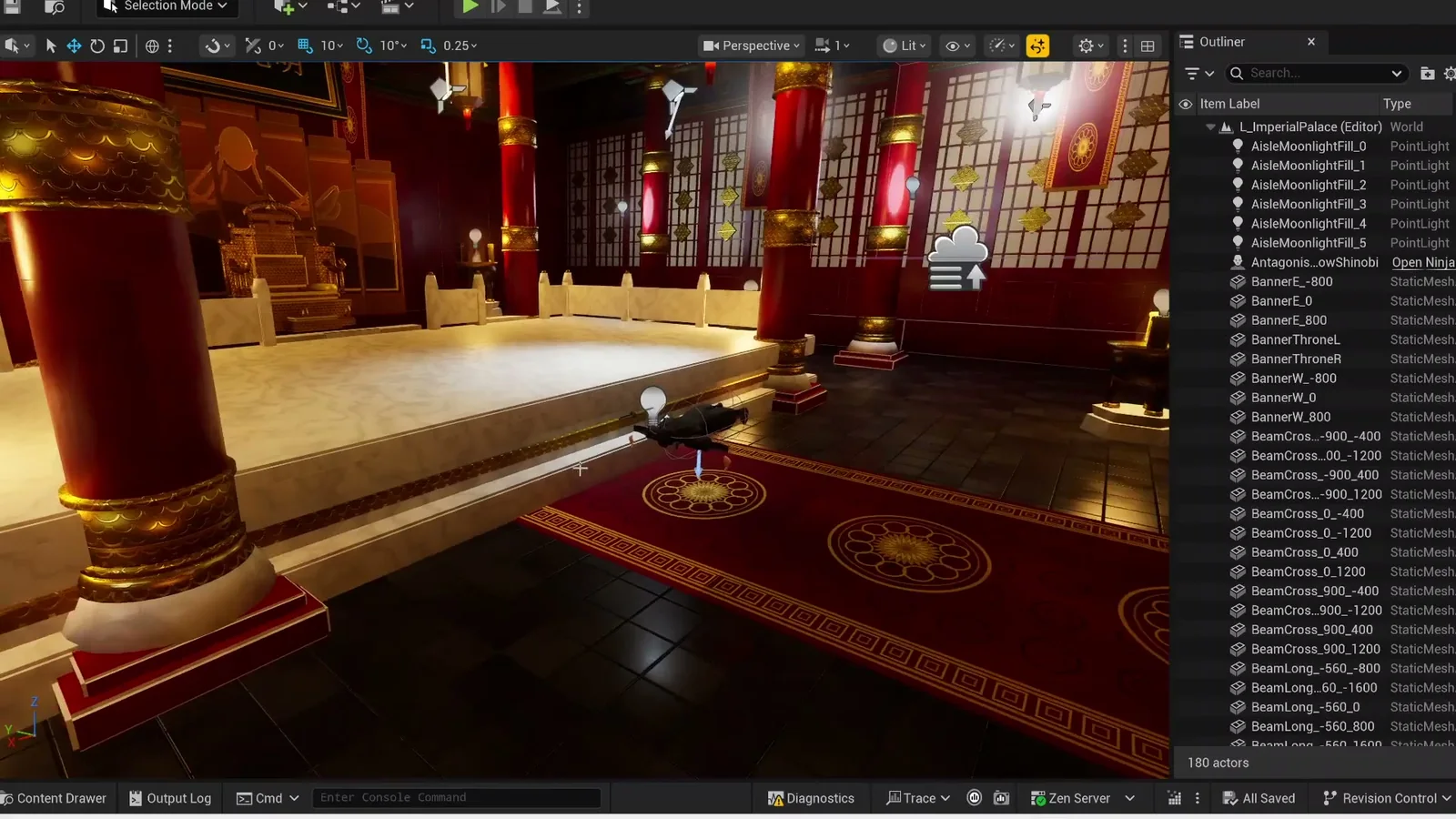
The hardest prompt: an Unreal Engine game in an ancient Chinese palace, with a realistic heroine and a ninja built from scratch in Blender, rigged and animated. A critic agent scored screenshots, and below 8.5 out of 10 Neon had to improve, for up to four rounds.
After about 40 minutes and four rounds, the critic gave it 4.5 out of 10. The characters had deformed joints and poor rigging and animation. AI Search expected no model to do this well, but said GPT-6.2 Astra handled it better.
19. An Airbnb rebuilt in Blender
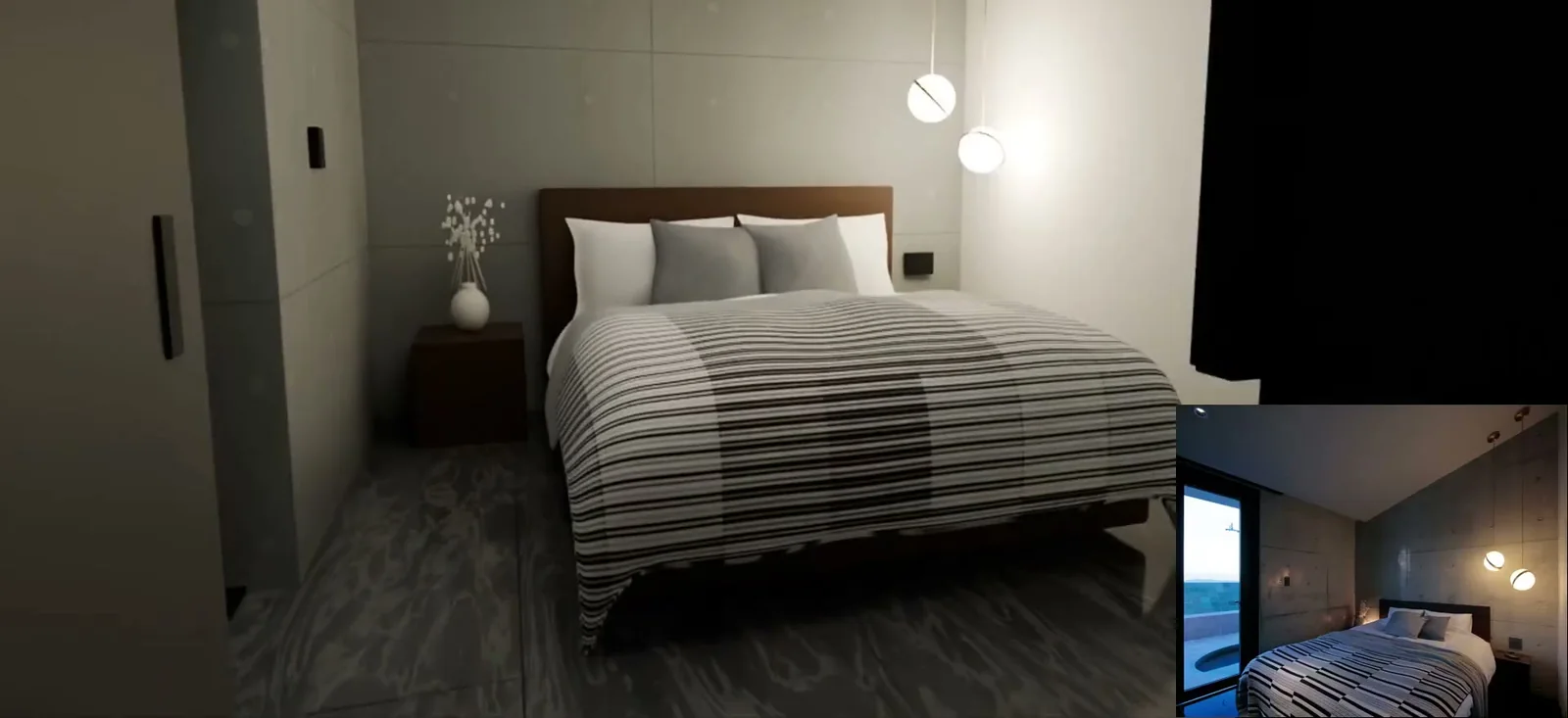
From a real Airbnb listing’s photos, Neon had to work out the layout, rebuild the building and interior in Blender, and fly a camera through it. It took 21 minutes; other leading models, including GPT and Opus, took over an hour. After one request for more detail, the layout was right, inside and out, with convincing furniture and lighting.
20. Plain-chat tests: frog, brain scans, research and ideas
In the regular Gemini chat the results were more mixed:
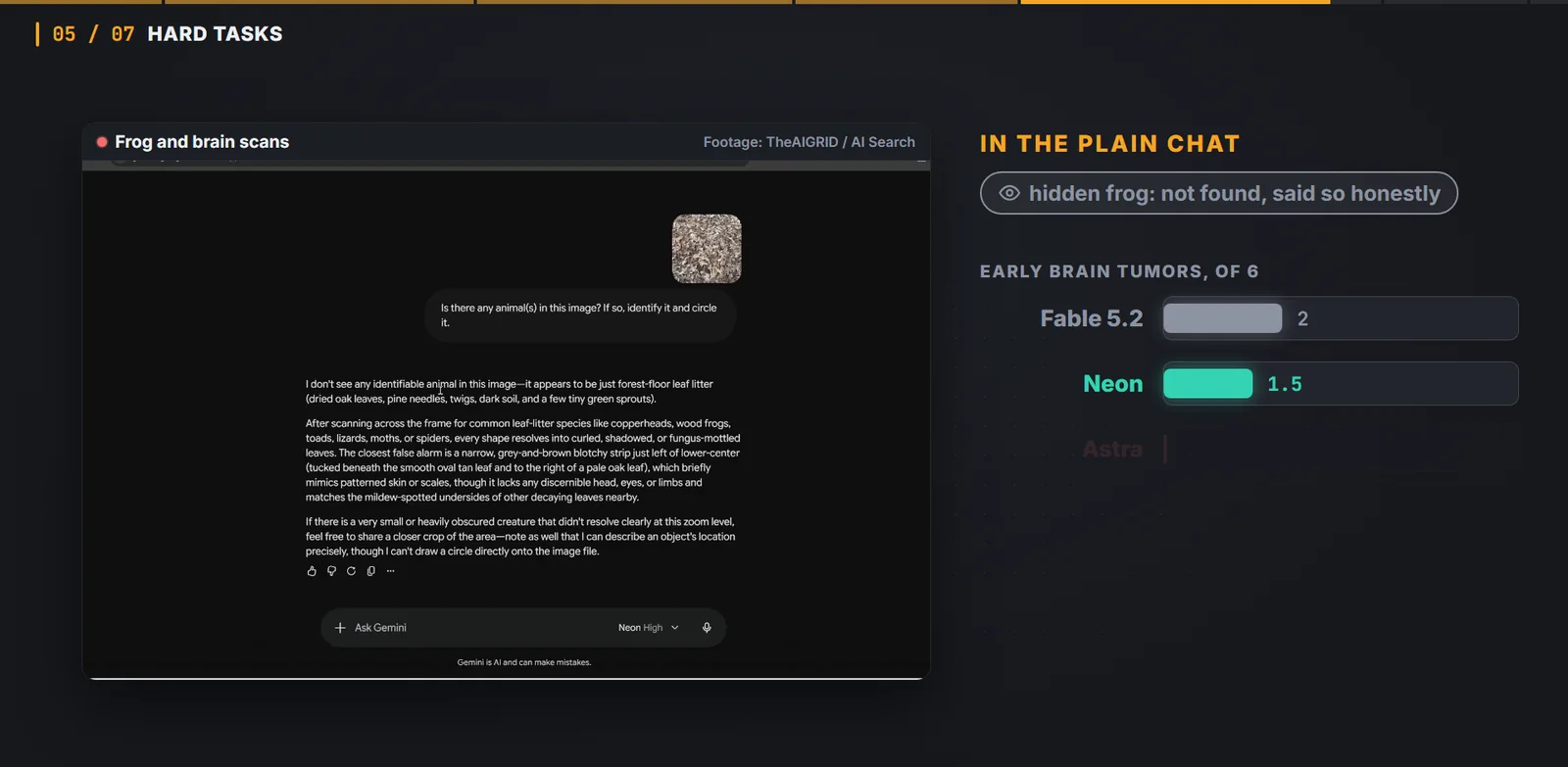
- Hidden frog: it found no animal in a leaf-litter photo, but said so plainly instead of inventing one.
- Brain scans: 1.5 of 6 early-stage tumors right. Claude Fable 5.2 got 2; GPT-6.2 Astra got none.
- Deep research on a type of leukemia: no citations and too wordy; AI Search preferred GPT’s answer.
- New ideas on plastic waste: three detailed proposals, again in long, jargon-heavy paragraphs.
All of these tests used only about 11% of the weekly limit on AI Search’s Google AI Ultra plan.
Part V — How Google Ships This Fast
21. A family built to work together
Gemini 4 is a family designed to hand work to each other. In Antigravity, Neon can orchestrate: it plans and checks while parallel Hydrogen sub-agents do the hands-on work. In one Google demo, Neon assigned eight parallel workers to a 3D synthwave mini-golf game; the modules came together into one engine and verifier, and the game was tested automatically in a real browser.
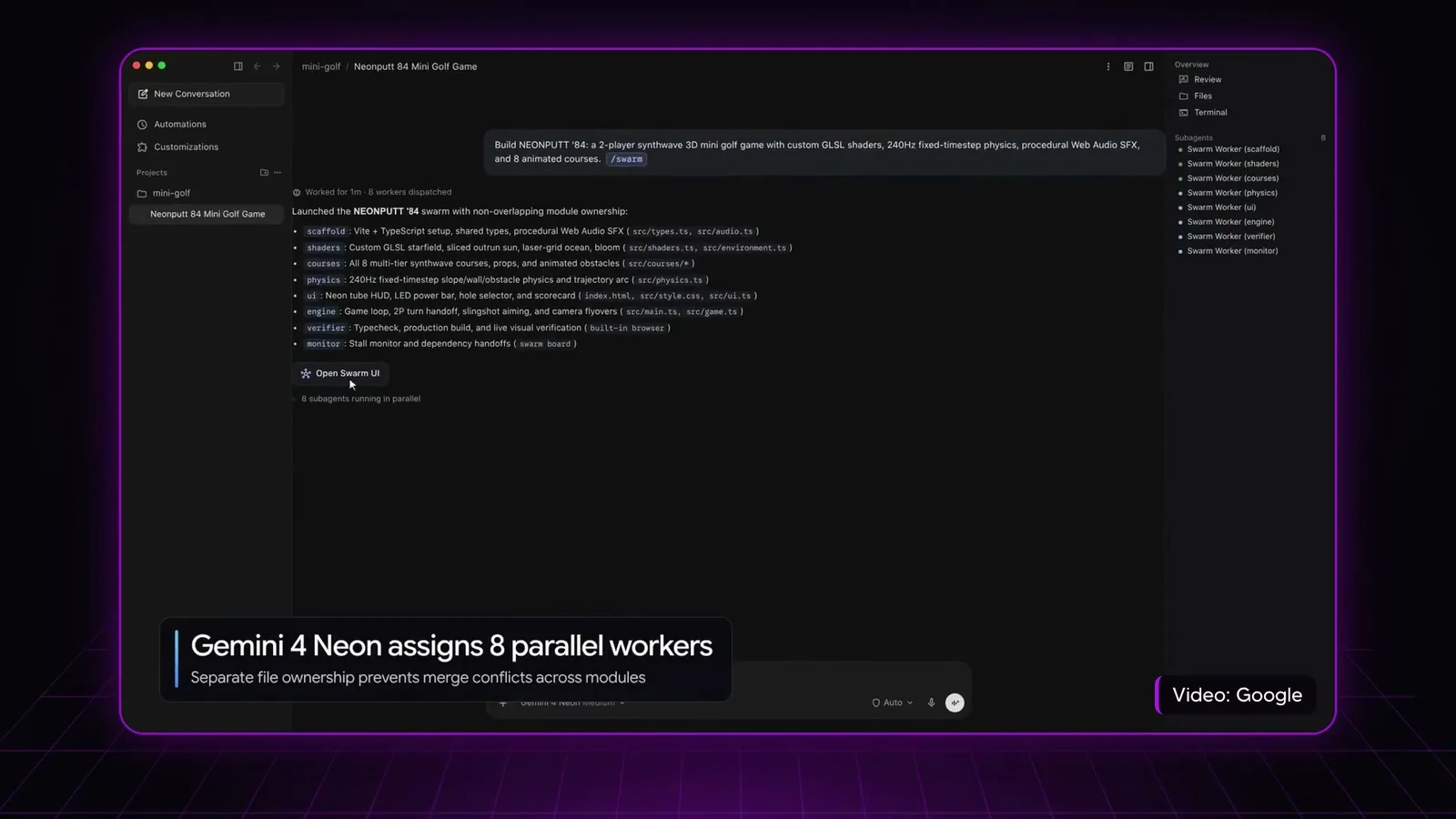
The Antigravity orchestrator launched with Hydrogen already switches between models within one session. On Terminal Bench 4, Google says it came close to Carbon’s success rate with 24% less quota and 19% faster.
22. The release curve and the “RSI treadmill”
Arena’s chart of release timelines shows OpenAI and Anthropic shipping major releases every few weeks while Google’s curve gets steeper. Sergey Brin said researchers and the model now work side by side on the next version, and called it the “RSI treadmill”: RSI means recursive self-improvement, AI helping build the next AI. Sundar Pichai was more careful: Google is still far from that end state, but agents already help its researchers.
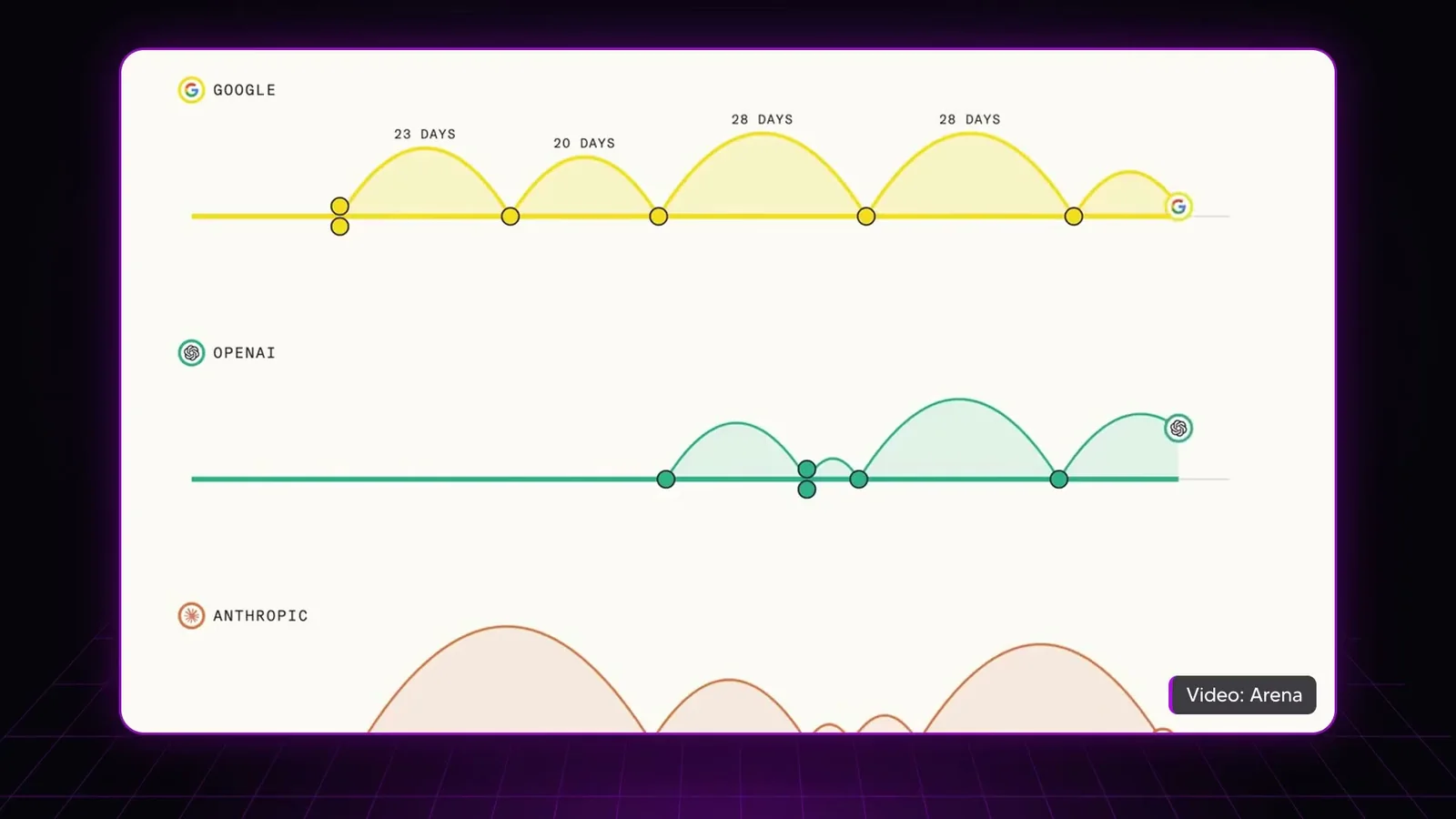
TheAIGRID adds practical reasons: Google’s own TPU chips, huge data centers, launch-day reach through Search, Android, Gmail and Workspace, and a model family where not every release has to be a giant leap.
23. What builders and Google’s demos show
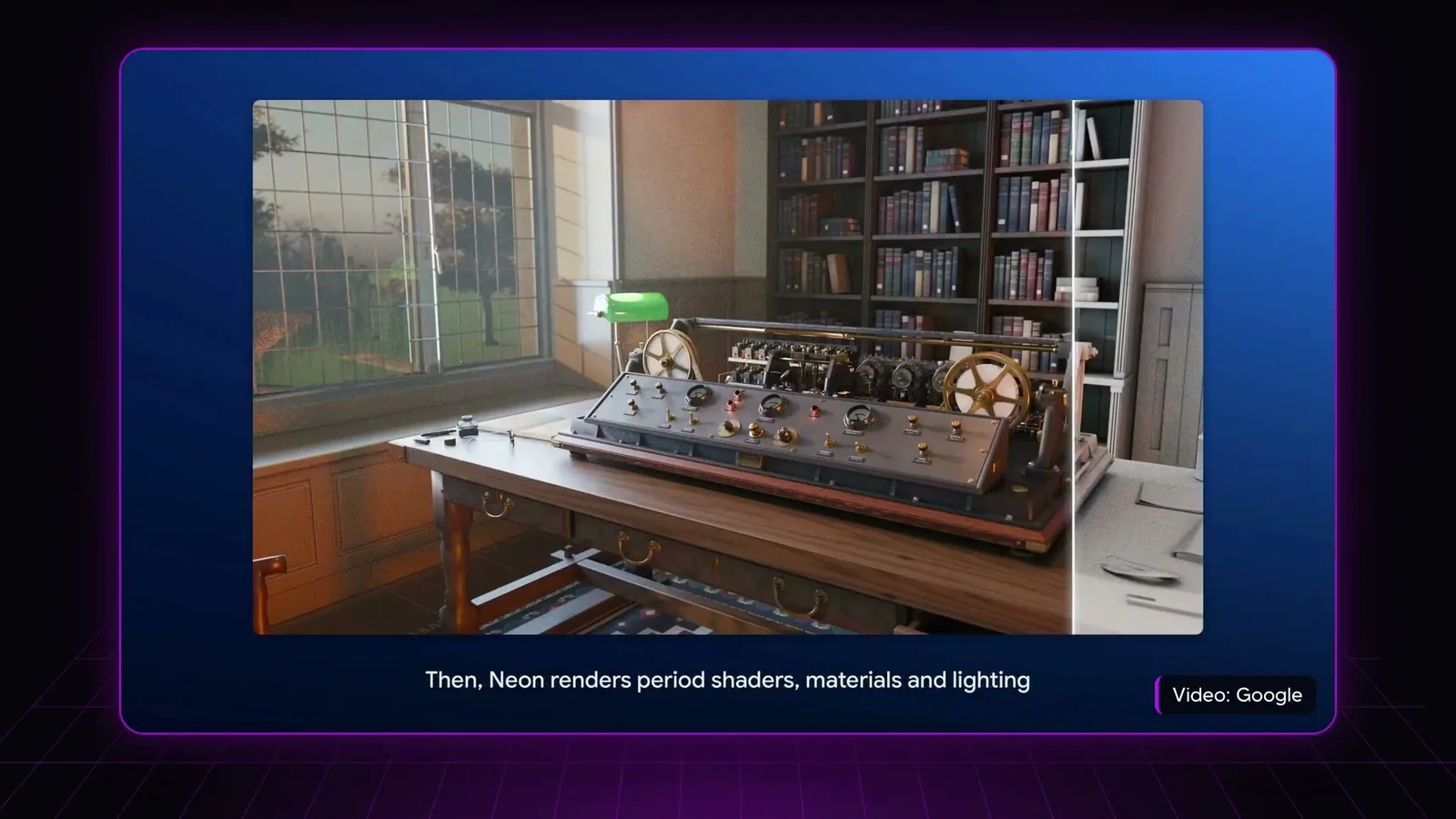
Greg Isenberg found Neon very good, fast and about half the price of what he was used to: about the same as Opus 5.5 on coding at almost half the cost per task, though he still picks Claude for the hardest problems. Google’s demos aim to show big ideas taken to finished products: Alan Turing’s 1936 study at King’s College, Cambridge rebuilt in interactive 3D, a Mont Blanc ski simulator with 10,200 lines of custom shaders, and an image rebuilt inside a 100,000-cell Google spreadsheet.
Final Perspective
Both reviewers reach the same broad conclusion. Gemini 4 Neon gives near-top performance at about half the cost per task of Claude’s best models, and it is fast. Claude Fable 5.2 still leads most major rankings. Neon’s weak spots are clear too: realistic characters from scratch, research without citations, and a wordy style.
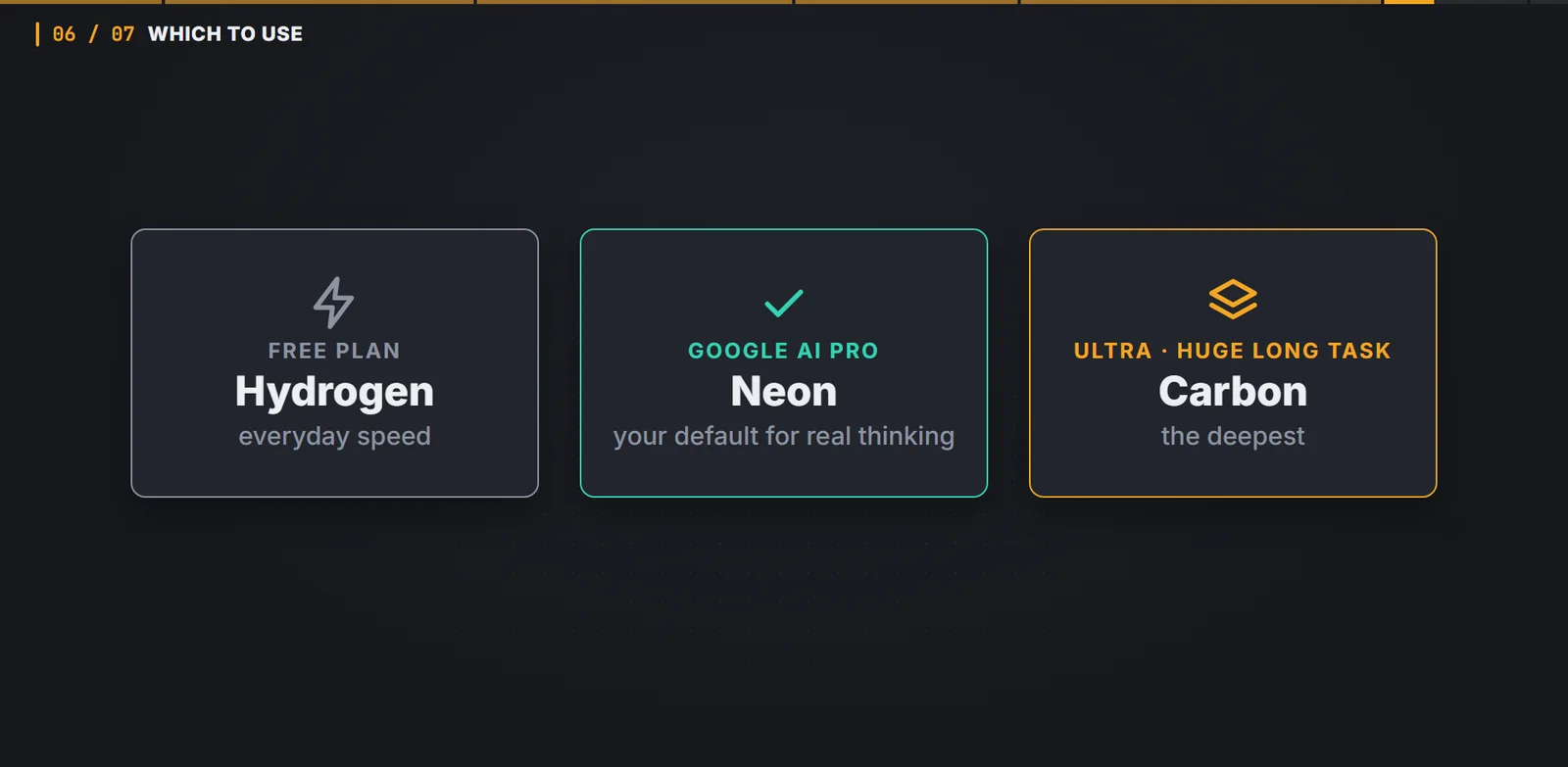
- Free plan: you get Hydrogen, not Neon: quick answers, everyday writing, fast code.
- Google AI Pro: make Neon your default for anything that needs real thinking: research, analysis, spreadsheets, large programming projects. Carbon needs Ultra, which AI Search says costs over $100 per month.
- Google AI Ultra and a huge, long task: choose Carbon.
- Developers: Neon as planner and checker, cheap Hydrogen agents doing the routine work in parallel.
- The very hardest problems: Claude Fable 5.2 still leads.
Both reviewers end with the same advice: test the models on your own work.
Quick Reference
| Question | Answer from the two reviews |
|---|---|
| What is it? | Google’s mid-range Gemini 4 model, released November 18, between Carbon and Hydrogen |
| Price | $3 in / $15 out per million tokens; cached input $0.15 |
| Overall rank | Third on the Artificial Analysis index (61), behind Fable 5.2 (65) and GPT-6.2 Astra (62) |
| Best results | First on the Coding Agent Index (59); 95.2% on Graph Walks; Vals at $7.40 vs $17.94 per test |
| Where it loses | Terminal Bench 4.1 and Frontier Code 2.0 (Opus 5.5); CWE-bench v2 (Fable 5.2) |
| Head to head | Beat Opus 5.5 and GPT-6.2 Astra on both Three.js prompts, fastest of the three |
| Clear failure | A 3D sword-fight game in Unreal: 4.5 / 10 |
| Use it when | You pay for Google AI Pro, run agents all day, or need long context cheaply |
| Use something else when | Free plan (Hydrogen), huge tasks on Ultra (Carbon), the hardest problems (Claude Fable 5.2) |
Further Reading and Source Notes
- Source video 1: “Gemini 4 Neon Just Shocked The AI Industry” by TheAIGRID
- Source video 2: “Gemini 4 Neon is on fire!” by AI Search
- Google’s announcement, as listed by TheAIGRID: “Introducing Gemini 4 Neon”
- Video summary by AIBotRadar: “Gemini 4 Neon vs Opus 5.5 vs GPT-6.2: Two Reviewers’ Real Tests”.
- Screenshots are frames from the two reviews (which include clips and charts from Google, Arena, Artificial Analysis, Vals and other publishers), shown for commentary and education with credit to TheAIGRID and AI Search. Diagrams are original.
- Benchmark scores and prices are quoted as the reviewers reported them at release time. TheAIGRID’s newsletter segment and AI Search’s Luma sponsor segment are not covered here.
Educational summary and commentary on two reviews. Benchmark scores and prices are quoted as the reviewers reported them from Google, Artificial Analysis, Vals, Arena and other publishers at release time; check current figures before you choose a model or a plan.