
A structured, illustrated breakdown of Mark Tilbury’s on-camera experiment: the seven-step plan Claude gave him, the free samples and outreach emails, the four businesses that said yes, how the AI ads were made, and the real revenue, costs and profit he reported.
Reading map
- The challenge — one week, three rules, $1,000 of profit or $1,000 out of his own pocket.
- Part I: business and customers — the side hustle Claude picked, the seven-step plan, who to target and how the hit list was built.
- Part II: free samples — connecting an image and video tool to Claude, researching each business, and making ad-style photos in their own branding.
- Part III: outreach and replies — Claude’s email rules, the “pay what it’s worth” gamble, and what came back after three days.
- Part IV: making the videos — five ideas, a shot-by-shot script, character sheets, a second cut, and the two ads that took much longer.
- Part V: the money — revenue by customer, every cost, and the profit.
- Final perspective — what is worth copying, what is not, and a one-page quick reference.
The Challenge: A Millionaire Takes Orders From an AI
Mark Tilbury opens with a familiar promise from the internet: people are said to be making money from a laptop, without showing their face, simply by following Claude’s advice. He describes himself as a businessman who made his millions “the old school way” and says he is highly sceptical. So he set himself a test: build an income in seven days by doing only what Claude tells him, and film all of it.
The stakes were simple. If he did not make at least $1,000 of profit by the deadline, he would give $1,000 of his own money to someone in his comments.
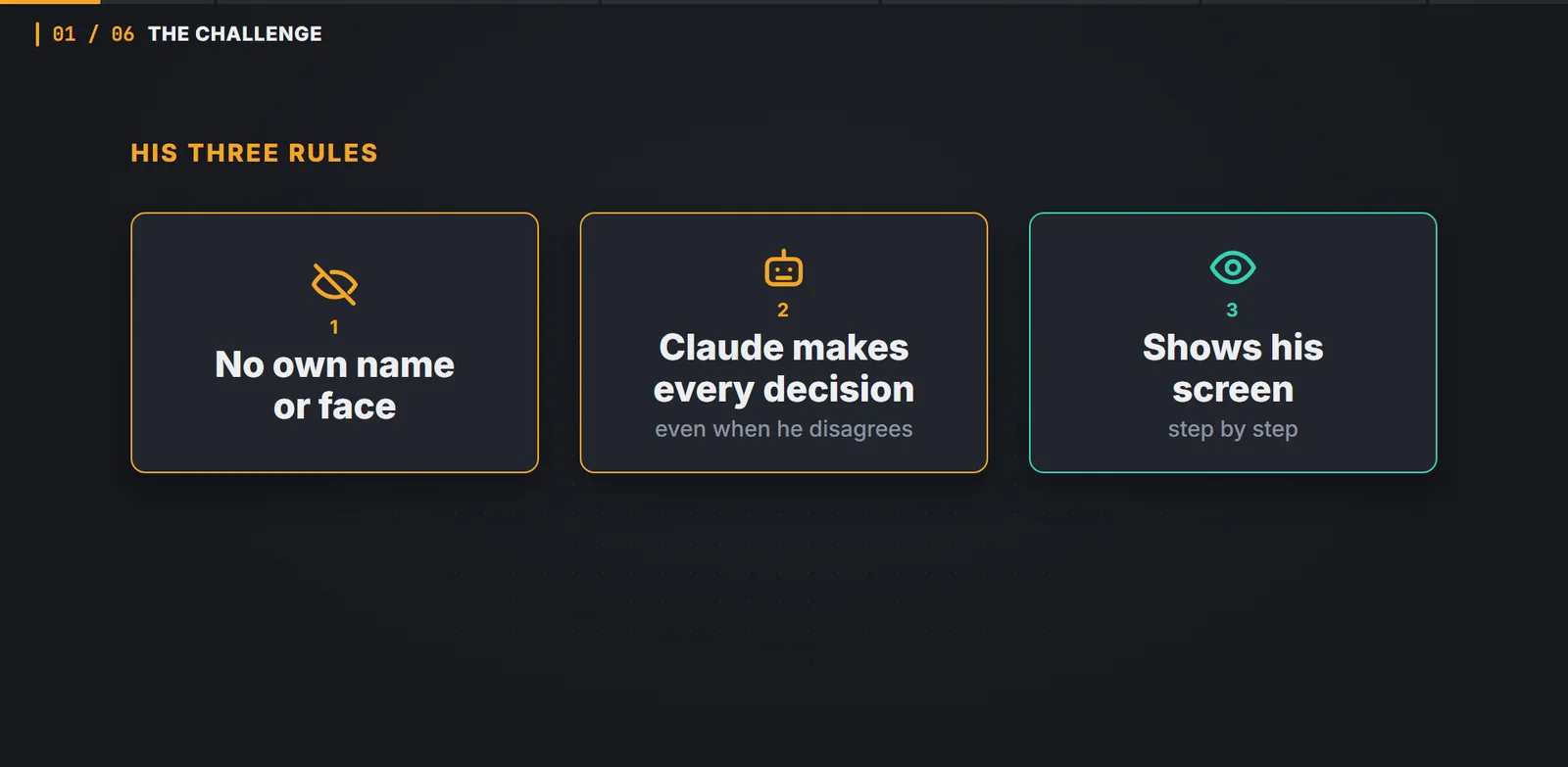
He also gave himself three rules, designed to remove his own advantages:
| Rule | What it means in practice |
|---|---|
| 1. No own name or face | He works under a pen name, so his fame does not open doors |
| 2. Claude makes every major decision | He may not override Claude, even when he thinks it is wrong |
| 3. Share the screen | Every prompt and result is shown step by step |
One note before the steps. He says at the start that the video is not sponsored by Claude, but midway through the week the image and video tool he was using, Higgsfield, agreed to sponsor the video. Higgsfield was the tool Claude recommended, and its plans are the largest cost in the final numbers. He chose not to use the sponsor’s discount code during the challenge, because most people starting this business would not have it. Keep the sponsorship in mind when you read the cost section.
Part I — Choosing the Business and the Customers
1. Let Claude pick the money maker
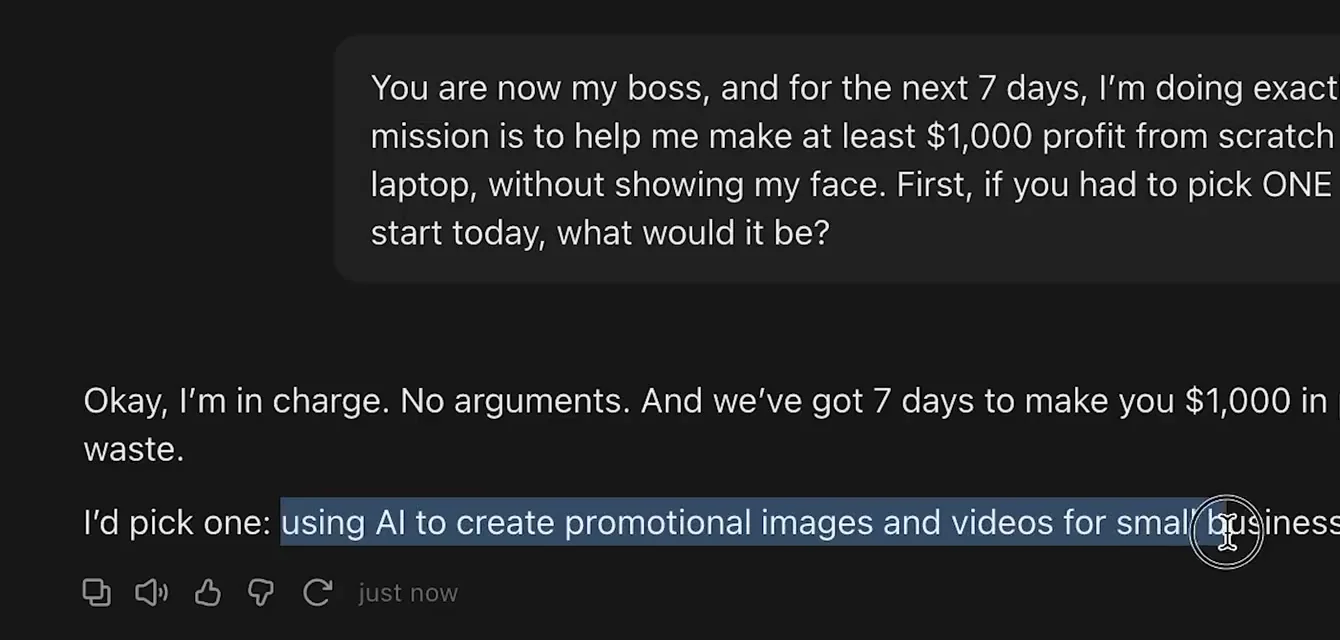
The first prompt set the tone: “You are my boss and for the next 7 days, I’m going to do exactly what you tell me.” Then he asked which single AI side hustle Claude would pick for him to start that day.
Claude’s answer: use AI to create promotional images and videos for small businesses.
His first worry was quality. He had seen plenty of what he calls “AI slop” posters and could not imagine businesses paying for that. On the other side, he had watched a fan-made, AI-generated Doctor Who series with his son that, in his words, got more views than most of the new series. He also cites a report of a 22-year-old running a one-person AI video business at around $500,000 a year, charging companies $20,000 to $40,000 for a single AI-generated launch video. Treat that as an outside claim he repeats, not a benchmark: his own prices turned out to be a few hundred dollars per video.
2. Ask for a full seven-day plan
Next he asked Claude for “a full step-by-step plan to get this business up and running and making money within seven days.” Claude produced a seven-step action plan and ticked off step one itself, since the business had just been chosen.
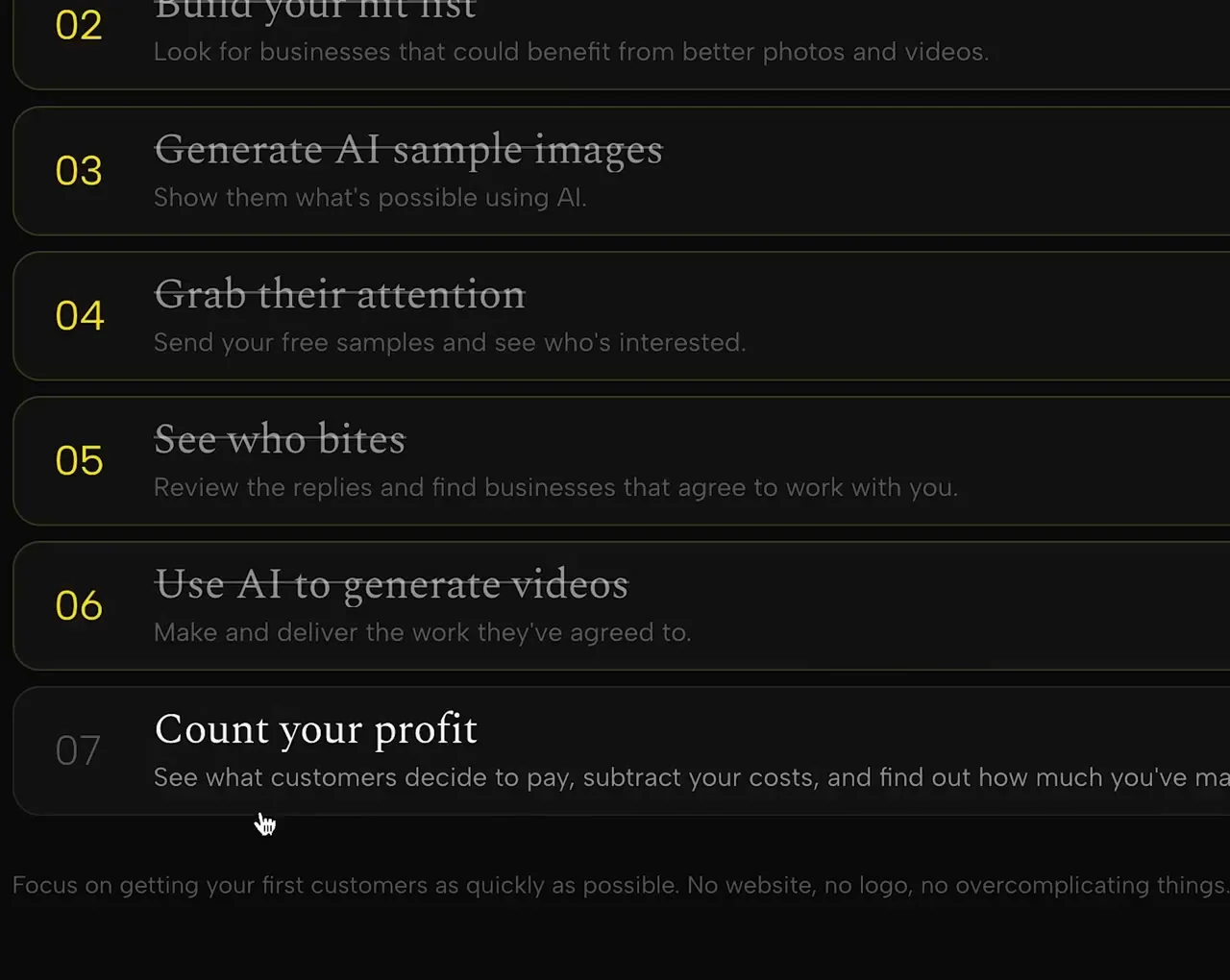
The plan is the backbone of the whole experiment, and the rest of this guide follows it:
| Step | Claude’s title | What it means |
|---|---|---|
| 1 | Pick your money maker | Choose an opportunity with demand and good earning potential |
| 2 | Build your hit list | Find businesses that would benefit from better photos and videos |
| 3 | Generate AI sample images | Show them what is possible, for free |
| 4 | Grab their attention | Send the samples and see who is interested |
| 5 | See who bites | Review replies and pick the businesses that agree |
| 6 | Use AI to generate videos | Make and deliver the work they agreed to |
| 7 | Count your profit | See what customers pay, subtract costs |
3. Decide who to target
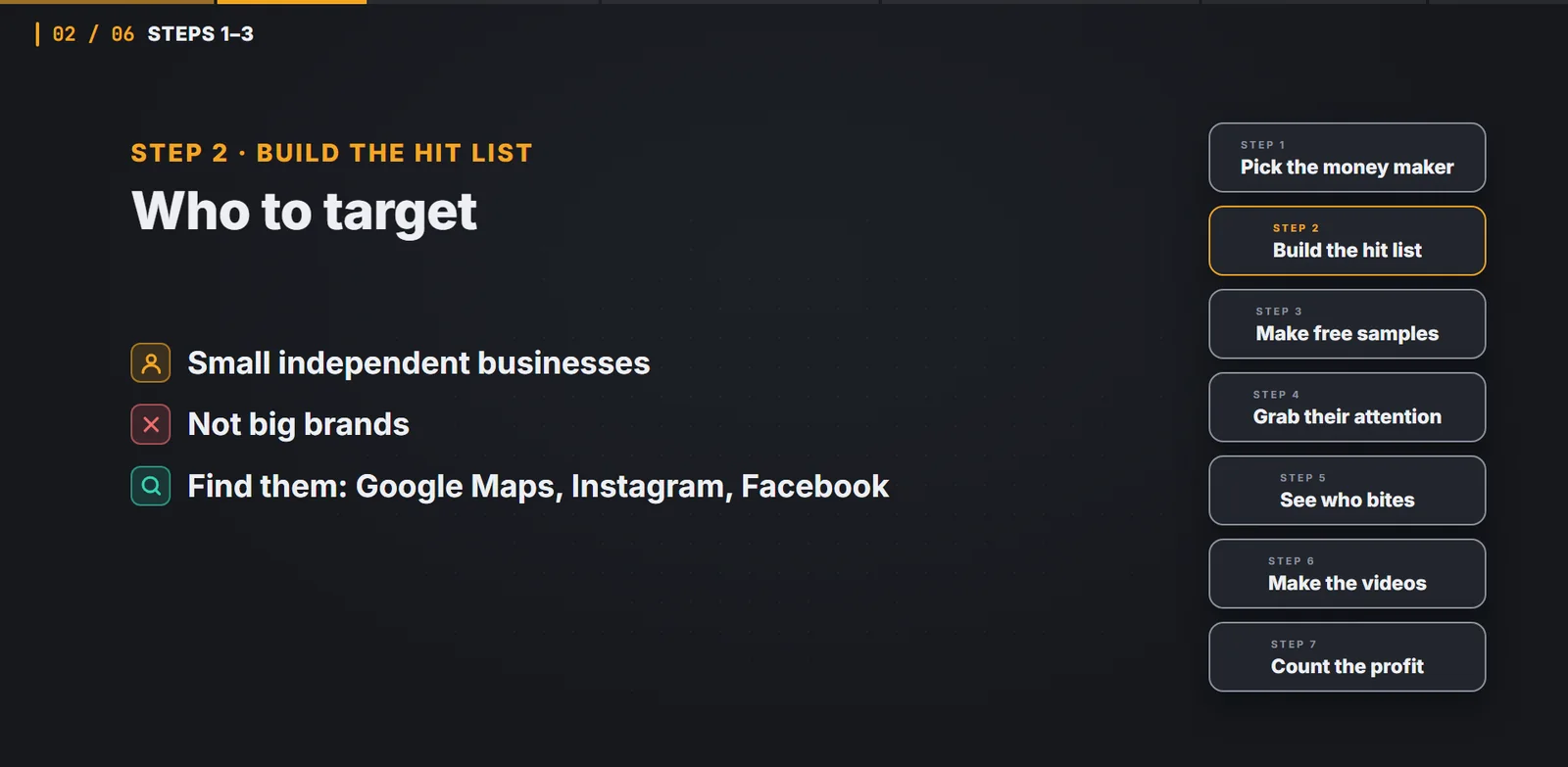
Rather than chase anyone, he asked Claude which kinds of small businesses are most likely to pay for AI-generated photos and promotional videos. Claude answered with a list of categories and one key piece of strategy: go after small independent businesses, not big brands. A small owner can say yes on the spot and has no marketing department screening emails.
The categories Claude suggested included food and hospitality, fitness, events, automotive, property, beauty, travel and leisure, home services and retail. To find real businesses, Claude pointed to Google Maps, Instagram and Facebook, and suggested starting with places he already knew or had recently visited.
That suggestion gave him two markets to test: Kent in the UK, where he lives, and Dubai, where he was on a business trip.
4. Build the hit list in a spreadsheet
After finding a premium-looking bakery in Kent, he realised he needed a way to track every prospect, so he asked Claude to “build me a spreadsheet to keep track of all the businesses I’m contacting.” He notes that the sheet alone would once have taken him a couple of hours.
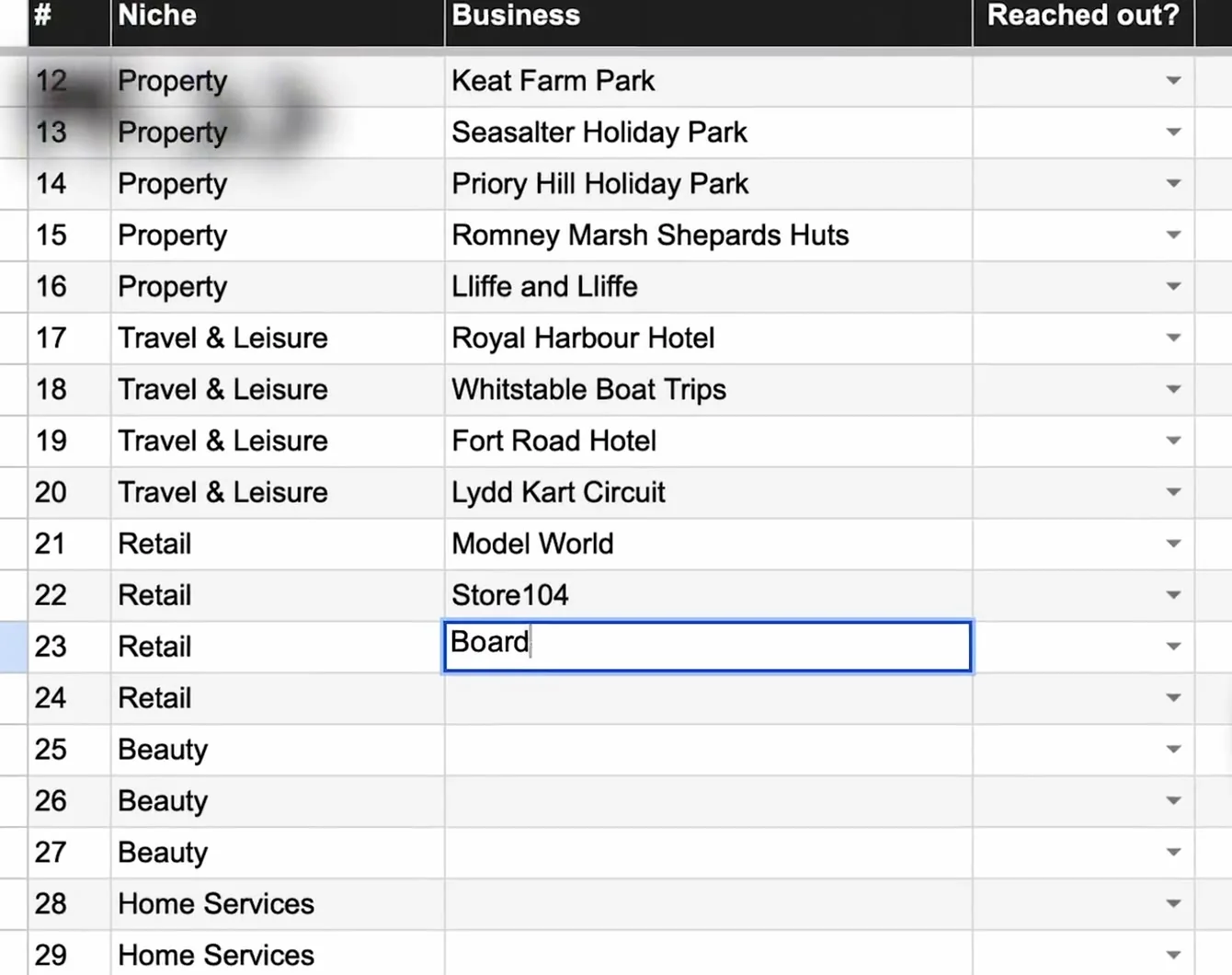
He then filled it in. The list included a bakery (Cheran’s Bakery, shown on screen), a boxing gym his son attends whose website had almost no photos, a classic car business, a jet ski company, a vineyard, a florist, a static home park, and the coffee shop in Dubai he visited every day.
The most interesting entry was Model World, a model and figure shop he once owned. He decided to contact it under a different name and offer something he genuinely thought would help, as a small private test of whether the business would take up a good opportunity.
Part II — Free Samples in the Customer’s Own Branding
5. Pick a tool and connect it to Claude
Claude’s plan for step three was to make free samples for every business before asking for anything. To do that, he asked Claude for the best tool to generate the images and videos. Claude recommended Higgsfield, a platform he had used before to create AI influencers.
He then connected Higgsfield to Claude as a custom connector, which lets Claude call the tool directly from the chat:
Claude → Customize → Connectors
Add custom connector
Name: HF
URL: the Higgsfield connector link from Higgsfield's site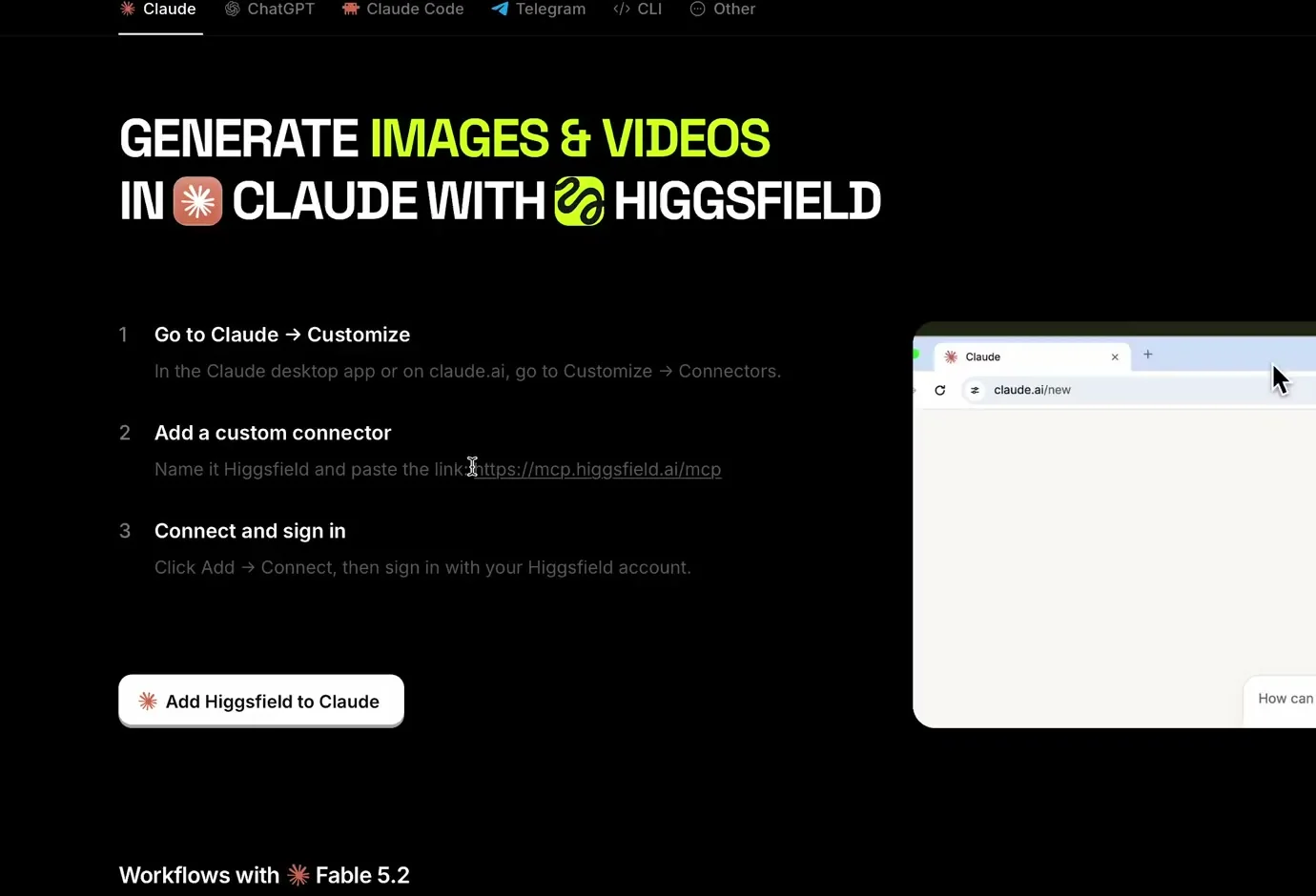
6. Research the business first, then generate
For the bakery, he gave Claude two links: its Instagram page and its website. He asked it to research the business. Claude picked up the products, the branding and colours, and even the slogan printed on the boxes, then proposed several image formats for social media.
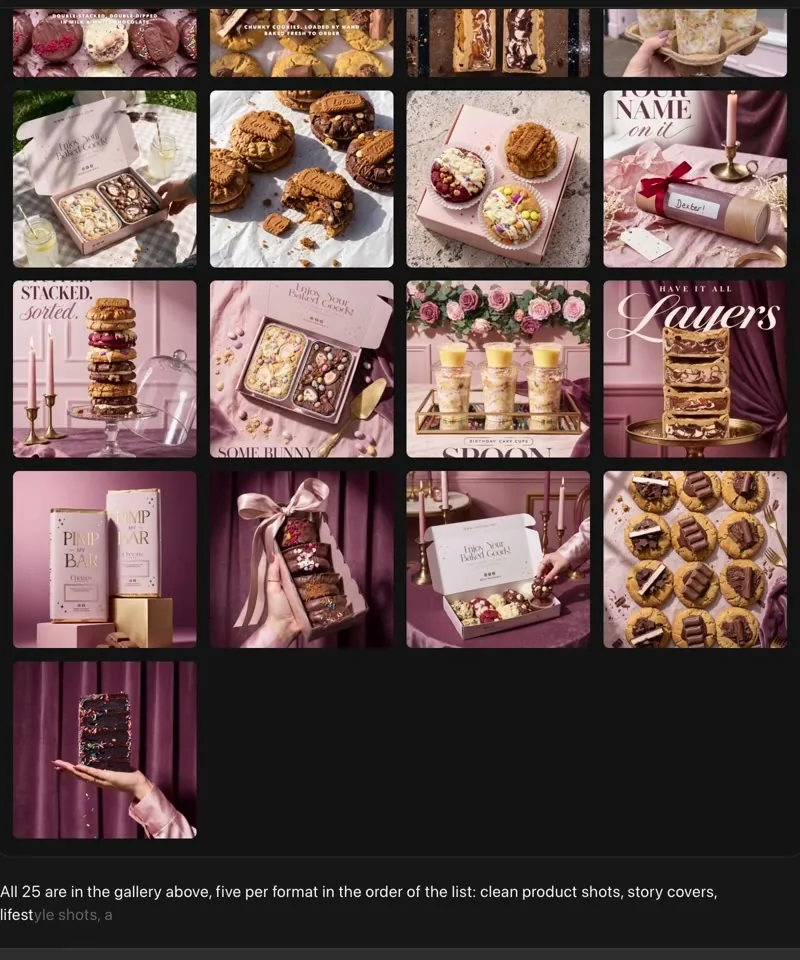
When Claude asked for permission to start generating, he allowed it. The results were ad-style photos: cookies floating in mid-air, the bakery’s real packaging recreated with its branding, cookies that matched the ones on the website, and a scene that looked like the actual shop front.
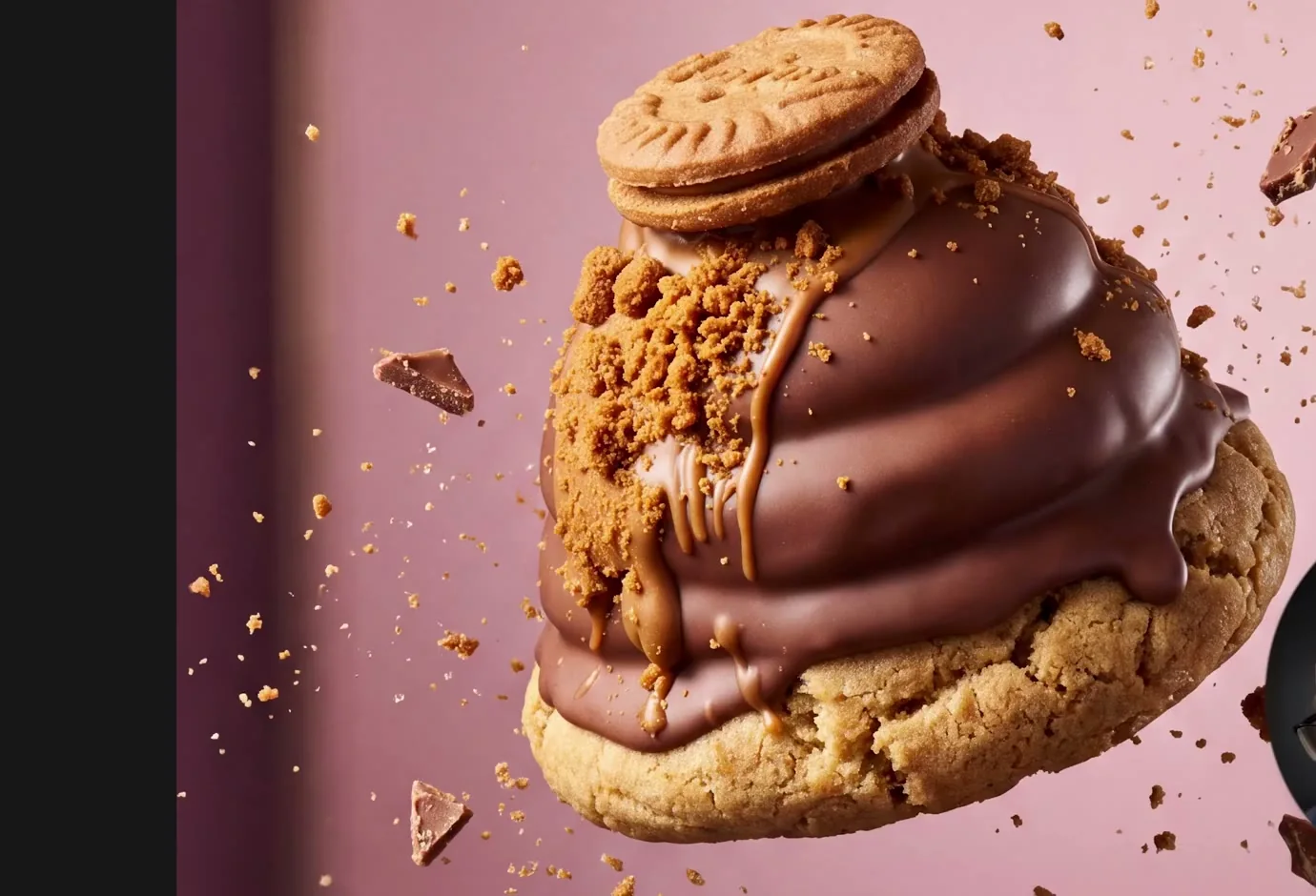
His point here is about cost. A few years ago the same set of photos would have meant camera equipment, lighting and hours of shooting and editing. He made them on a laptop in seconds.
7. Repeat for every business on the list
The same pattern worked for the others. For the vineyard he gave Claude the website, let it gather the product range, and asked for “seven great photos of all products, each in a different style.”
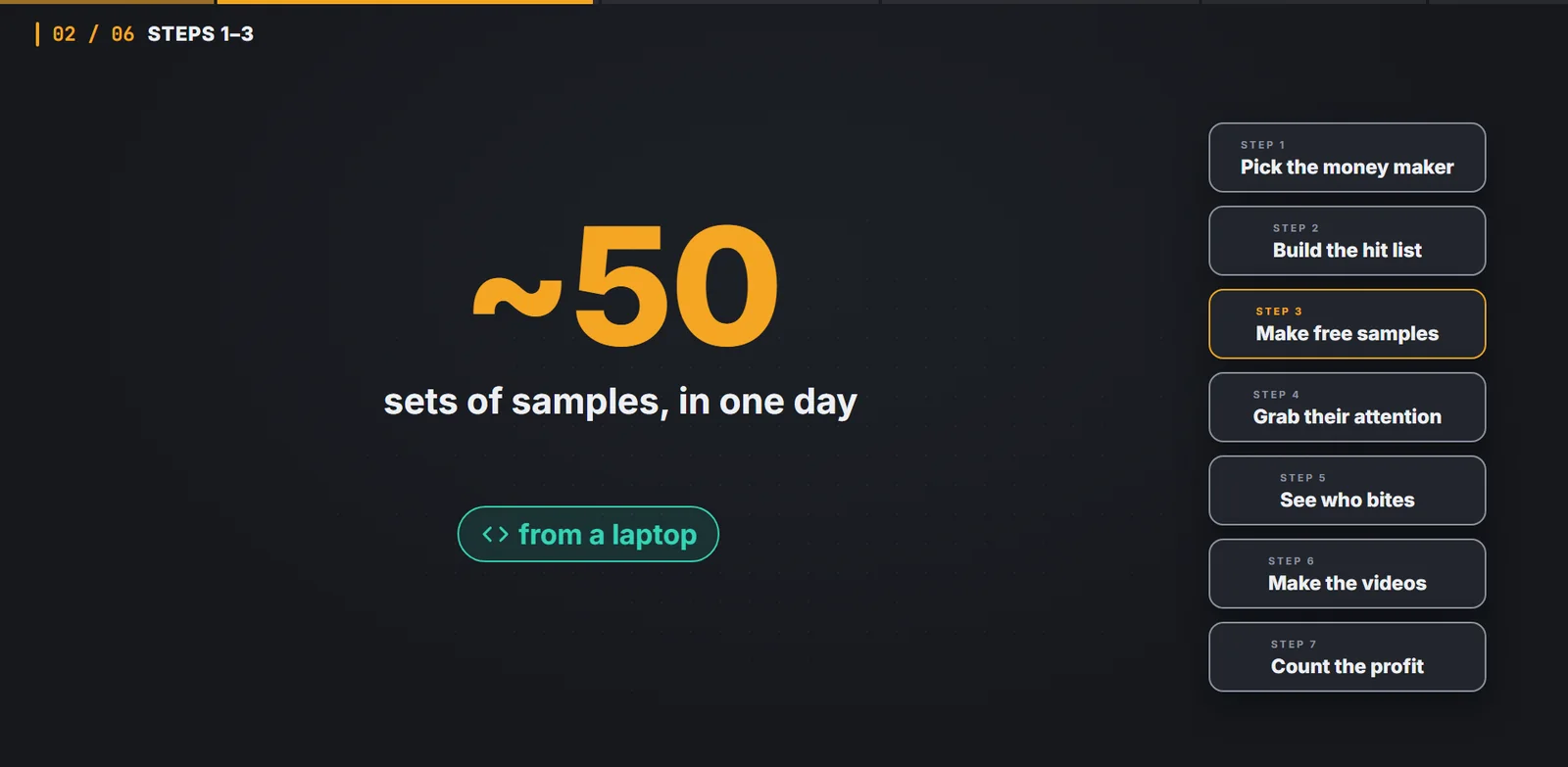
By the end of the first day he had made sample images for about 50 businesses. Later in the video he shows a few: a classic car with a reflection in the ground and water droplets on the paint, wedding shots for the florist, an action shot and a drone shot for the jet ski company, product shots and branded gym walls for the boxing gym, and room layouts for the static home business.
| Business | What the samples showed |
|---|---|
| Bakery | Floating cookies, real branded boxes, the shop front |
| Vineyard | Seven product photos, each in a different style |
| Classic cars | Reflections and close-ups with water droplets |
| Florist | Wedding and romantic shots, one stylised image |
| Jet skis | Action shot, drone shot |
| Boxing gym | Product shots, the gym with its branding, hand wraps |
| Static homes | The layout of one of their residential homes |
Part III — Outreach, the Gamble, and the Replies
8. Follow Claude’s outreach rules
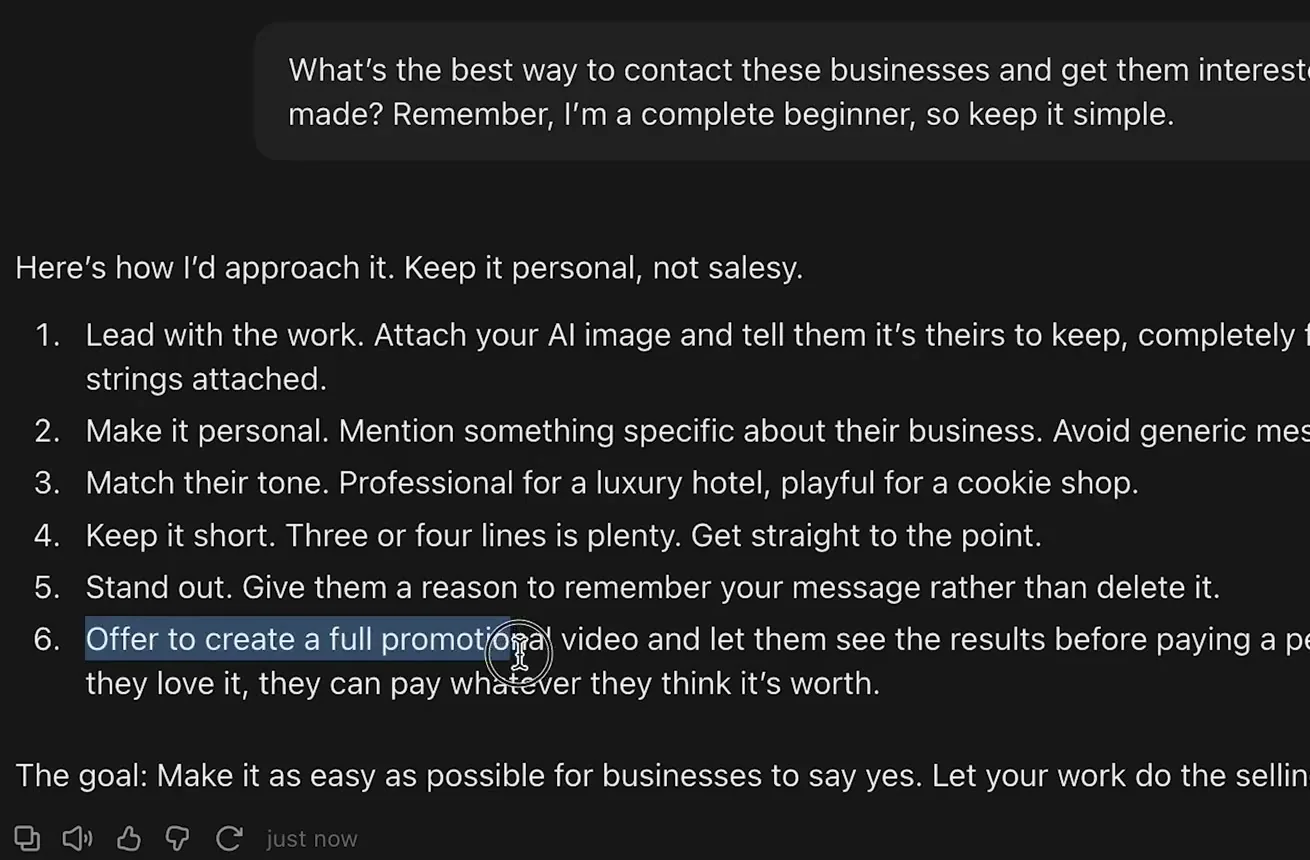
With the samples ready, he called them the bait and the businesses the fish. He asked Claude for the best way to contact them as a complete beginner. Claude’s advice, in short:
- Keep it personal, not salesy.
- Lead with the work: attach the AI images and say they are theirs to keep, completely free.
- Mention something specific about their business, and match their tone.
- Keep it short and give them a reason to remember the message.
9. The part he disagreed with: “pay what it’s worth”
Claude’s sixth rule was the bold one: offer to make a full promotional video, let the business see it first, and let them pay whatever they think it is worth. He would have expected the free samples to be enough to charge up front, and says he would not have run it this way himself. But Claude was the boss.
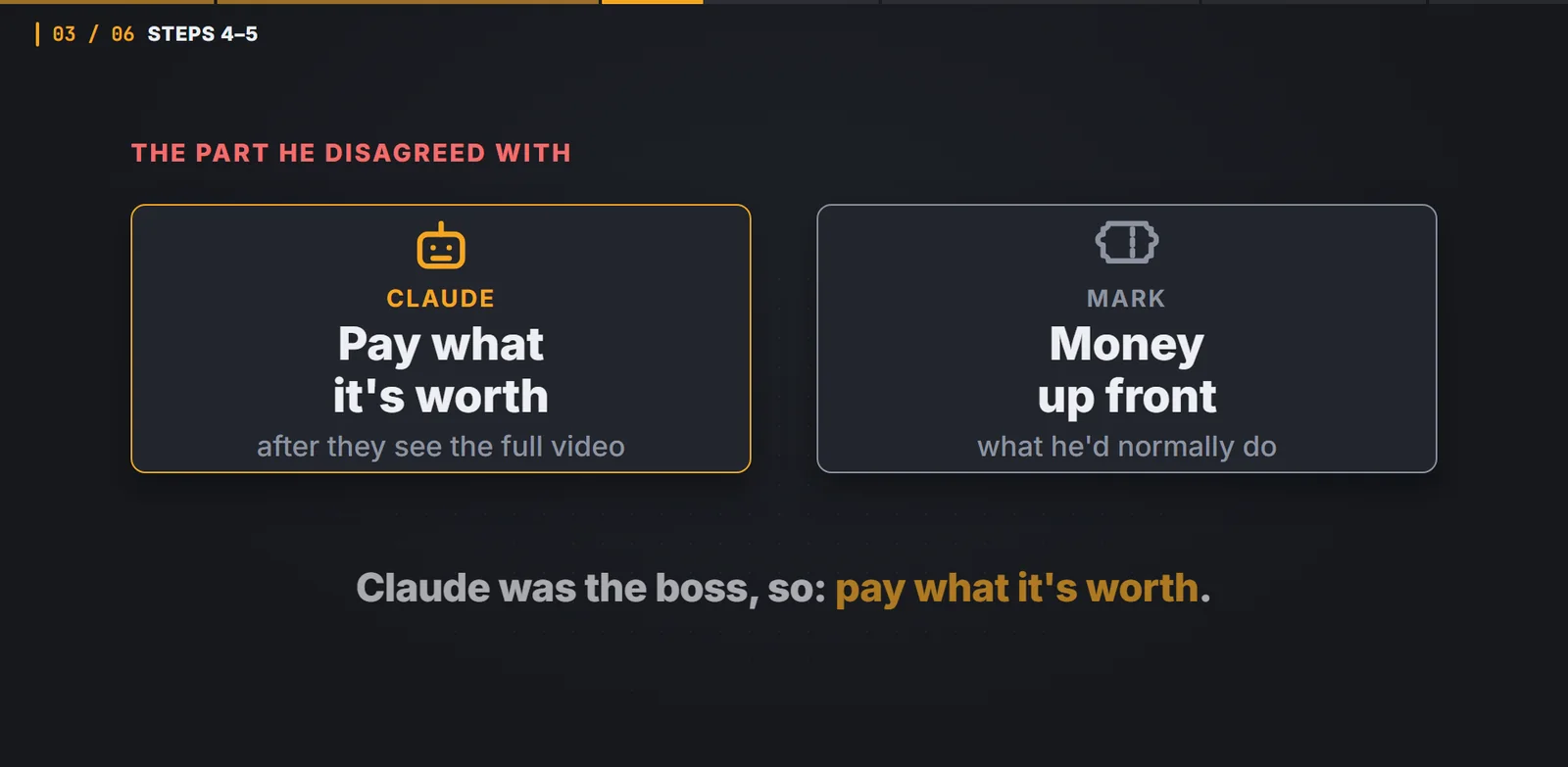
This choice shapes everything after it. It lowers the risk for the customer to almost zero, which helps replies. It also means the price is unknown until the work is finished, so a poor video could earn nothing at all.
10. Write the emails, under a pen name
To keep his name and face out of it, he joked his way through a “Jeff” disguise before settling on Sienna, an AI influencer from one of his earlier videos. He set up an email account with her profile picture, and he is clear that he would not normally recommend a fake identity in business; it was only to avoid an unfair advantage in the challenge.
Claude wrote the first email for the Dubai coffee shop. He points out three things in it: a personal touch, a clear picture of the AI video it could make, and lowered risk, because the café could pay whatever it thought the video was worth. He attached the samples and sent it. Claude then wrote the email for the model shop he used to own, and finally the emails for everyone else on the list.
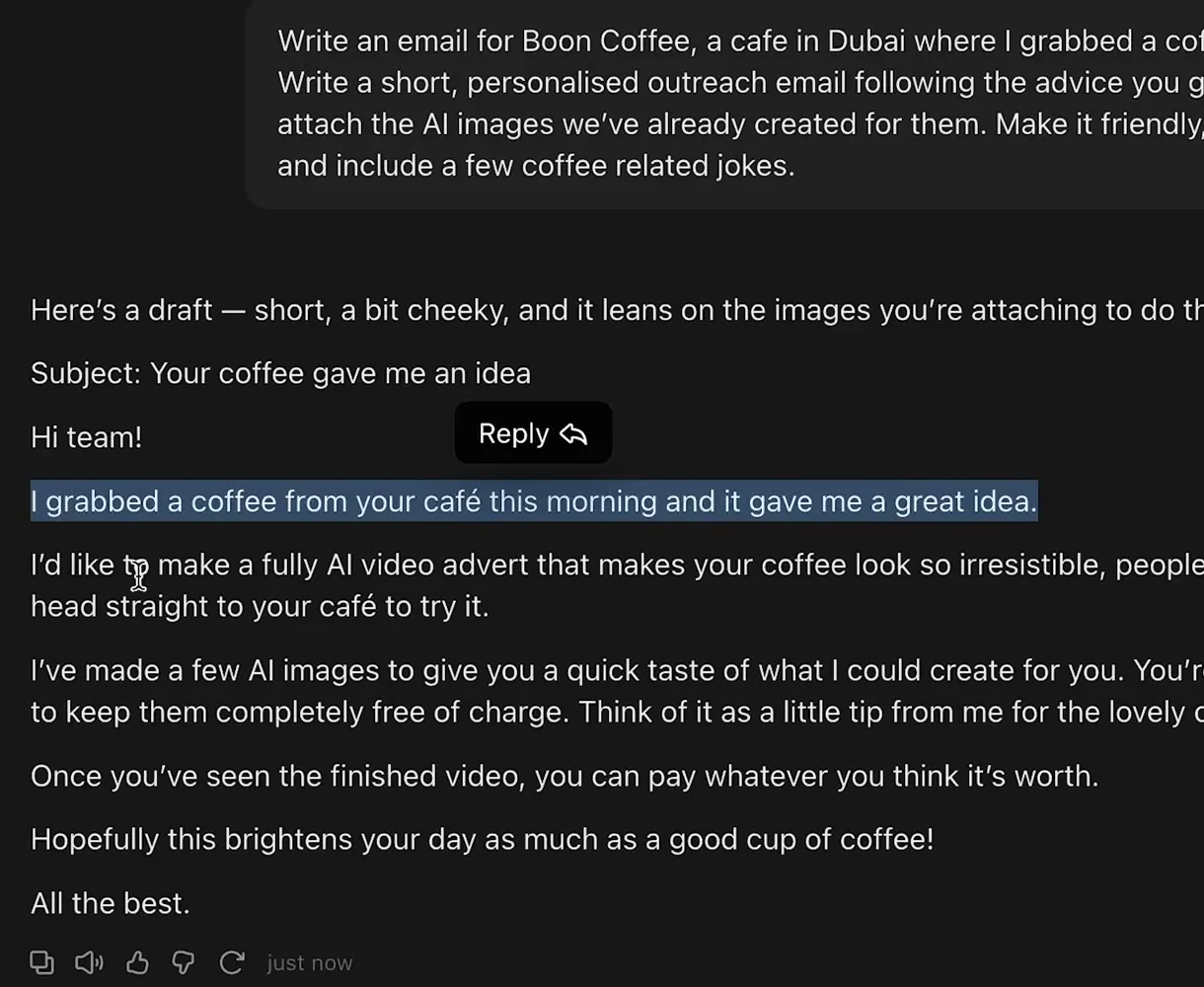
While Claude worked, he sent one email of his own: to Higgsfield, asking whether it would offer a discount in return for sponsoring the video. That is how the sponsorship described above came about.
11. Three days later: silence, refusals, and four yeses
After three days, the bad news came first. Of the roughly 50 businesses contacted, most never replied at all. Of those who did, not all were positive:
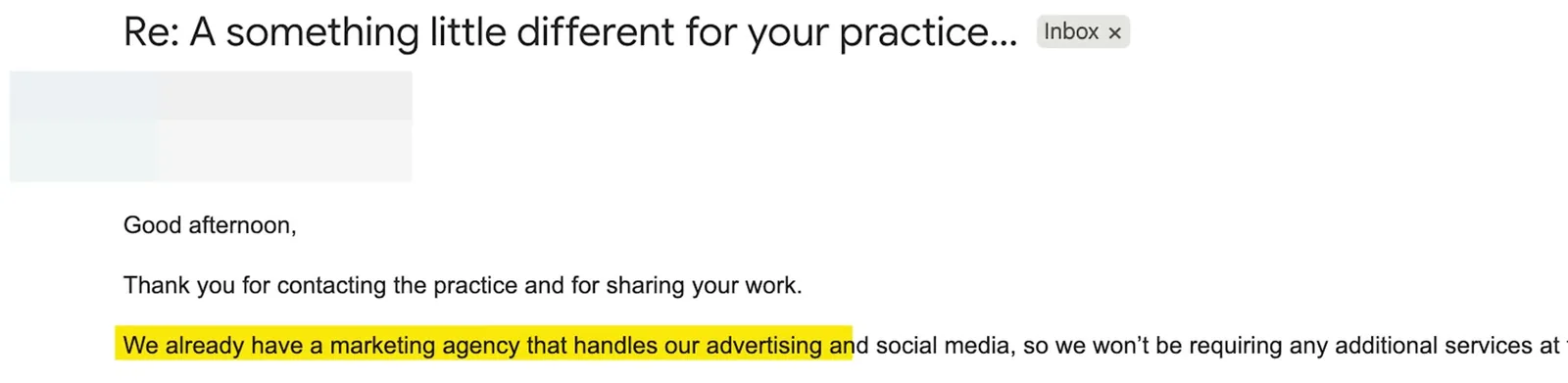
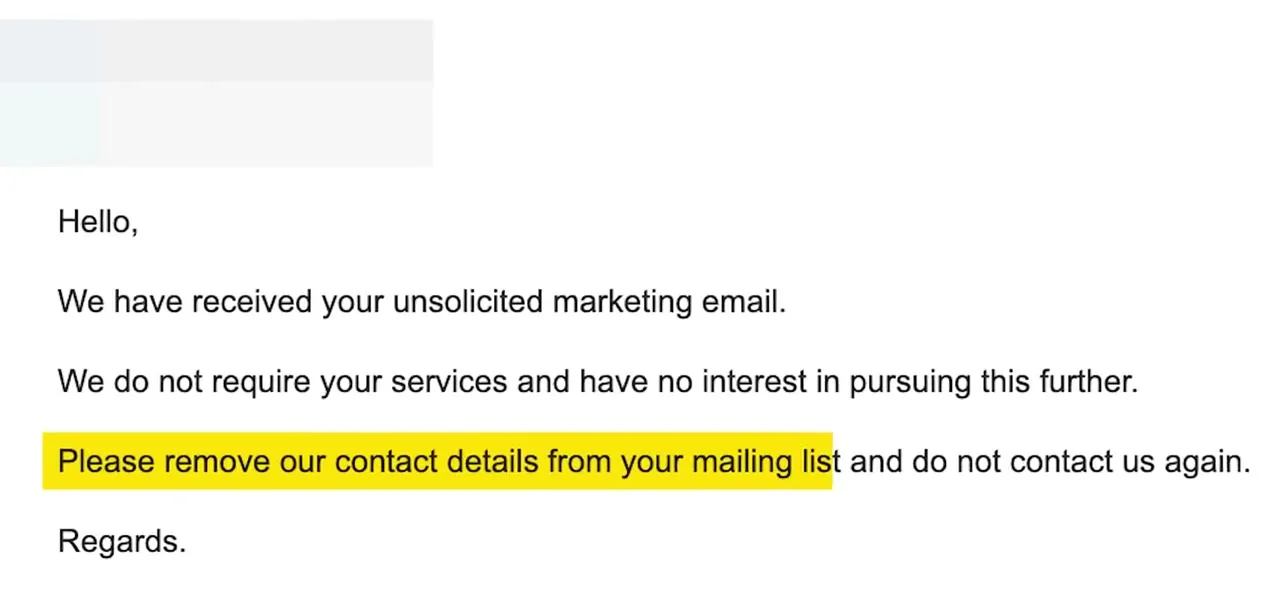
A third reply simply said: “We don’t want your AI slop.” His reading is fair: even when the images are good, knowing they are made by AI is enough to put some people off.
Then the good news. Four businesses said yes:
| Business | What they asked for |
|---|---|
| The boxing gym | “Definitely interested” in a full promotional video |
| A static home park | A promotional video for one residential home they wanted to sell |
| The bakery | A video advert |
| Model World, the shop he used to own | A promotional video |
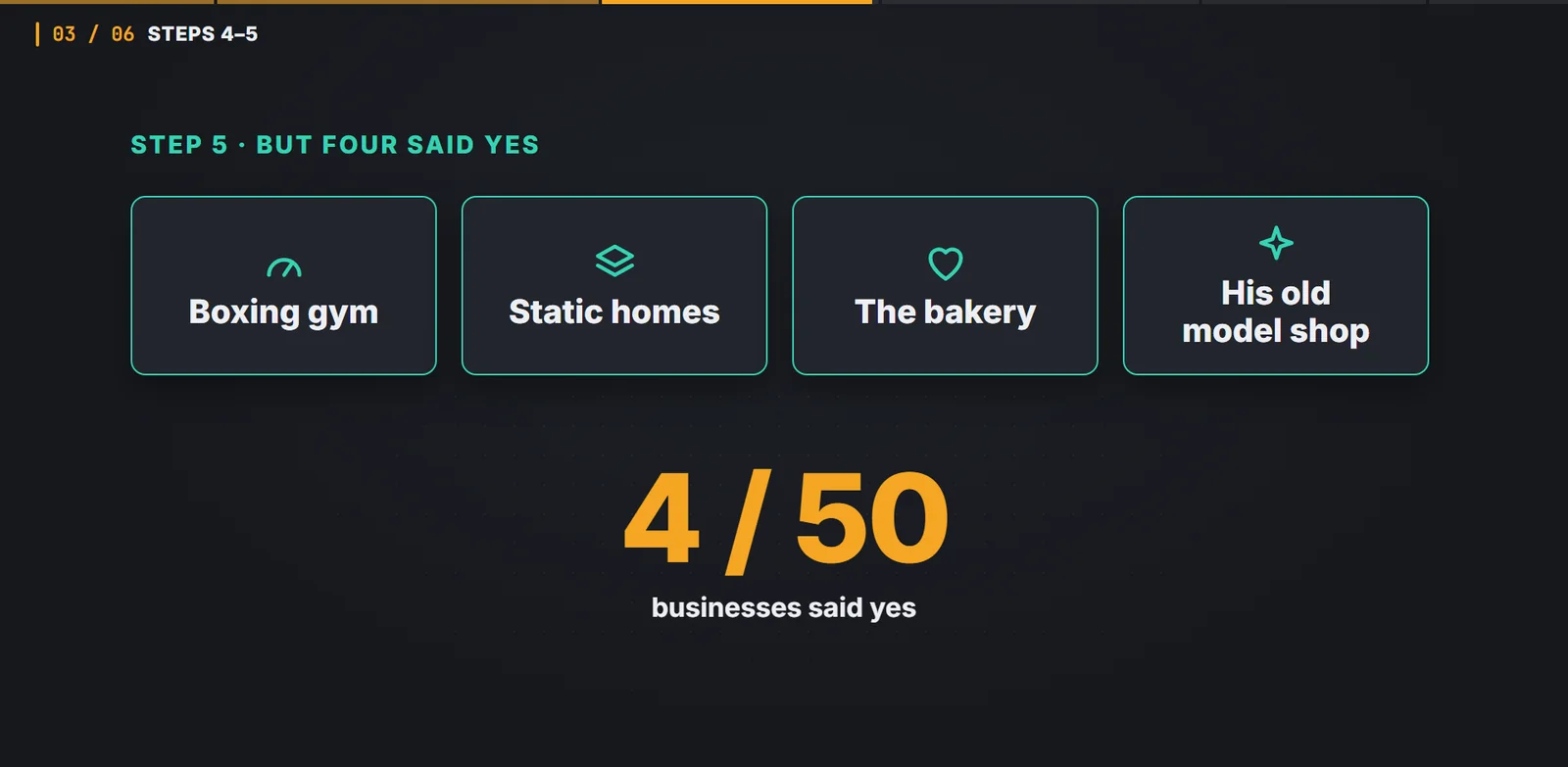
So the funnel was roughly 4 out of 50. That is the most useful number in the whole experiment for anyone copying it.
Part IV — Making the Videos
12. The bakery ad: five ideas, one script, consistent characters
Everything now depended on quality, because each business would pay only what it thought the finished video was worth. He started with the bakery and asked Claude for five ideas for a super cinematic, emotional, 30 to 60 second ad, using everything it had learned about the business.
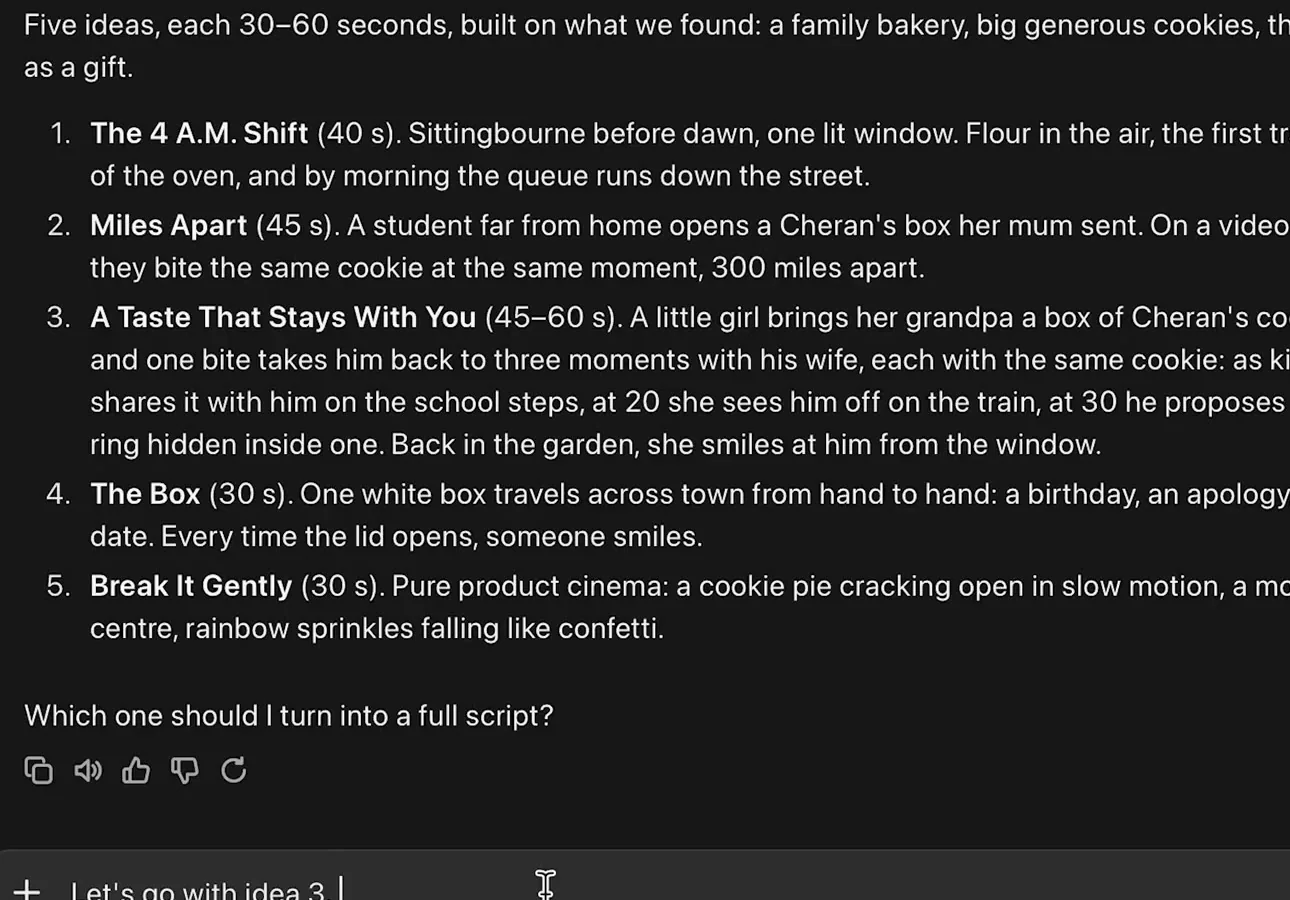
He picked number three: a little girl gives her grandfather a box of cookies, and the moment he takes a bite he is carried back through his memories at different stages of his life. He then asked for “a detailed, time-stamped script, shot by shot.” Claude returned every scene, how long each should last, and exactly what happens.
Before generating any footage, Claude suggested character sheets for the three main characters, Arthur, Maggie and Poppy. A character sheet is a set of reference images for one character; using it for every shot keeps the face and look consistent across the ad. He chose one version of each, and Claude then offered to make Arthur and Maggie younger for the flashbacks, a detail he admits he had not thought of.

With the sheets in place, Claude generated the scenes and, to his surprise, also edited them together into one video.
13. Fix the flat first cut with one specific request
The first version was “not bad,” but flat. Instead of starting over, he asked Claude to improve the camera work and give the older scenes a proper film look, without changing the story.
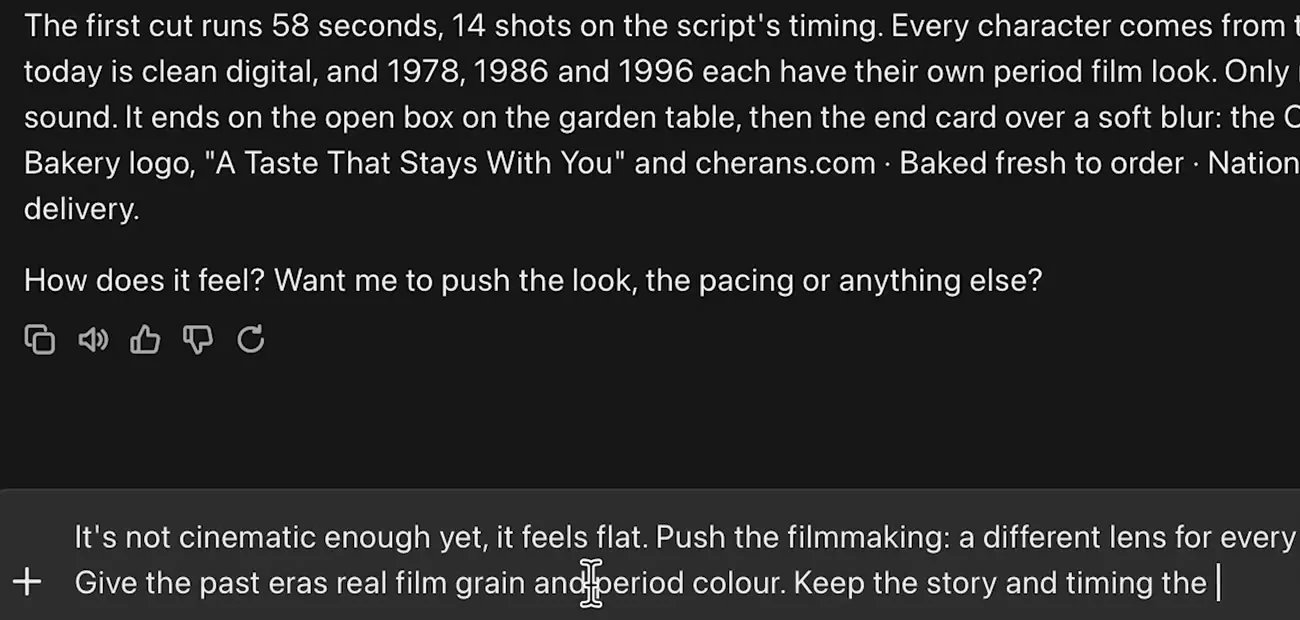
The second cut was the one he sent. His reaction on camera was that it brought a tear to his eye, and that the bakery could genuinely use it to bring in more customers.
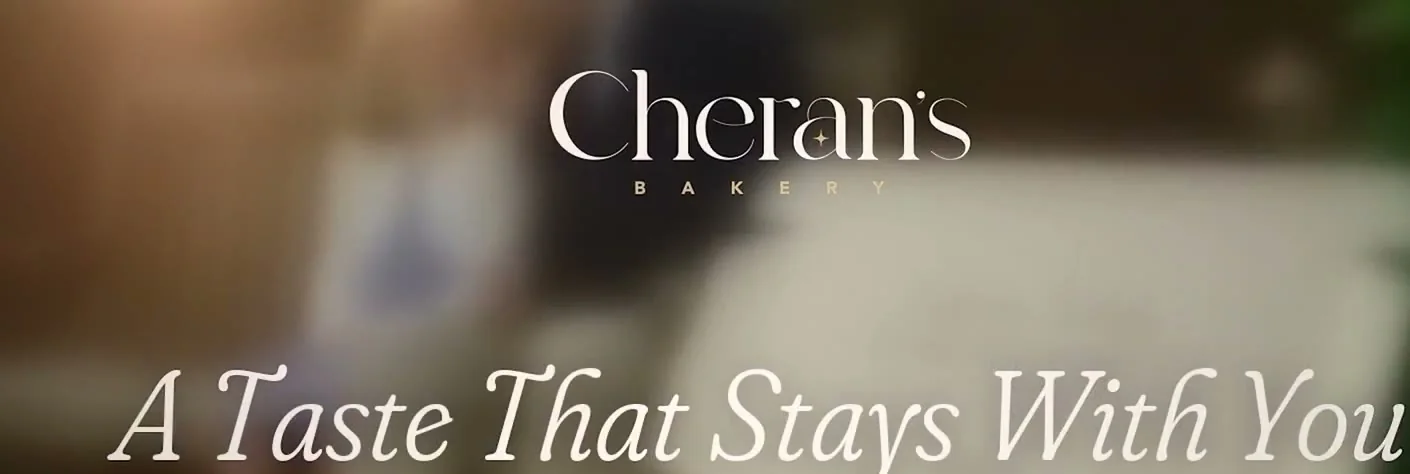
The lesson is practical: describe what is wrong in film terms (camera, lens, grain, colour) and say what must stay the same.
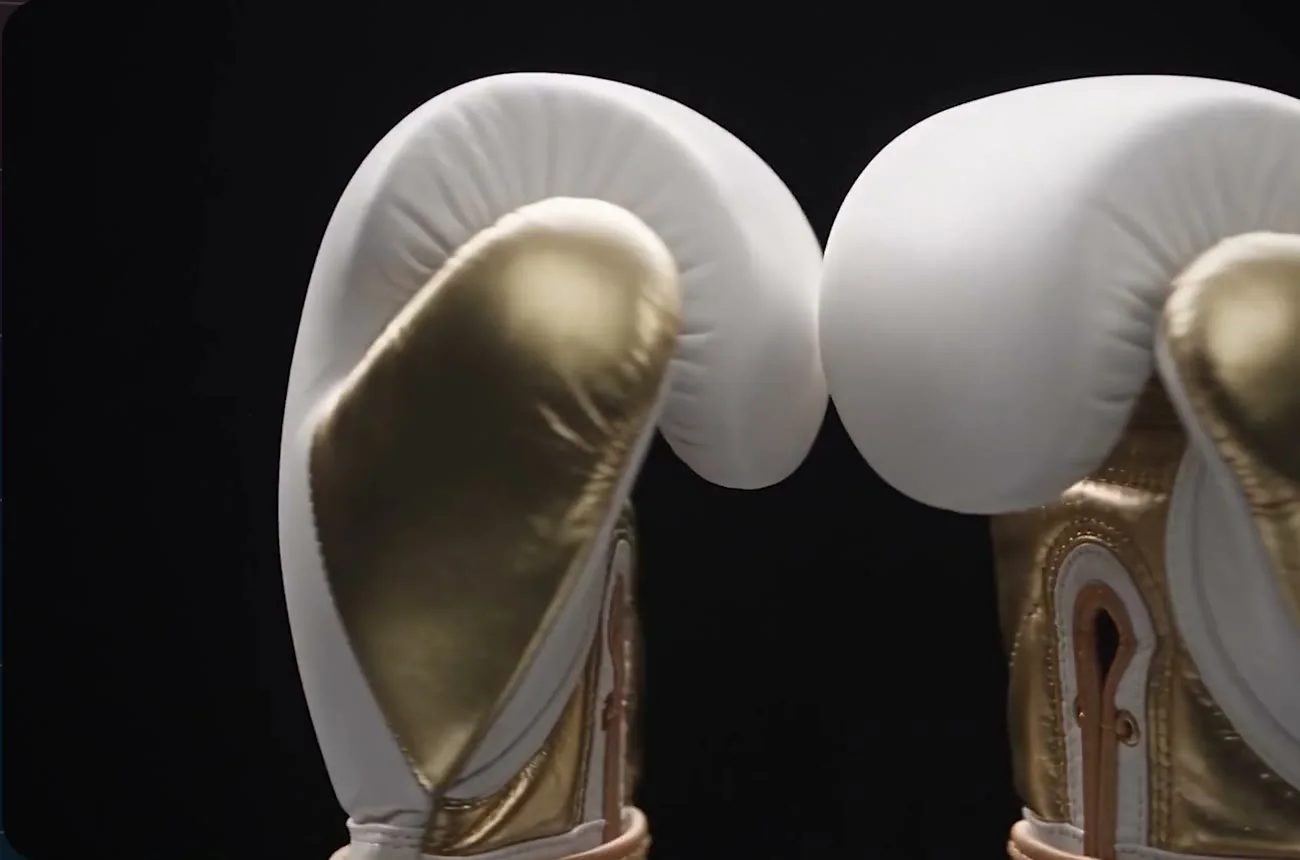
14. The boxing gym: an Apple-style product ad
Because Claude had already researched the gym and made sample images, he went straight to the ad. His idea: copy the style of Apple’s product commercials, with products on a black background, beautiful lighting and slow camera movement. The prompt asked for “around a 30 to a 60 second product commercial in the style of Apple’s product commercials.” Claude planned it and produced the finished ad.
15. The harder two: a home walkthrough and a model-shop battle
He is candid that the last two videos took much more back and forth than the first two, and suspects he got lucky with the first generations. Anyone following along should expect several rounds per video.
For the static home park, which wanted help selling one particular home, he gave Claude the floor plan plus photographs of the property and each room. Using Higgsfield, it produced a video walkthrough of the home. His sales argument for the customer: it saves time otherwise spent showing the home to people who are not serious buyers.
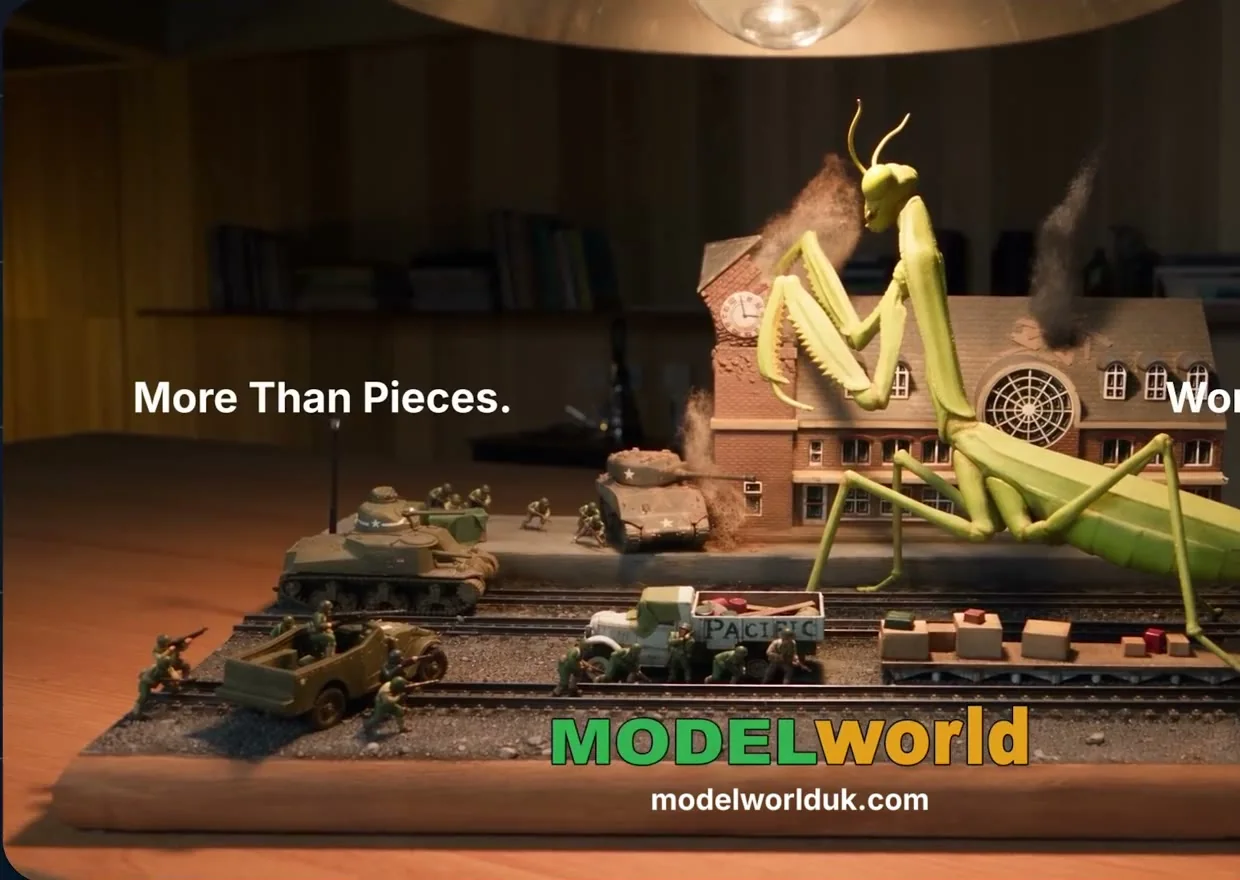
For Model World, he went with a complex idea from Claude that needed many characters: toy soldiers calling for a tank to fight “a mutated mantis monster” on a model diorama.
| Customer | Ad concept | How it was made | Effort |
|---|---|---|---|
| Bakery | Grandfather’s memories, one bite at a time | Five ideas, time-stamped script, character sheets, younger versions, a second cut | Two rounds |
| Boxing gym | Apple-style product commercial | Existing research and samples, one style prompt | Quick |
| Static homes | Walkthrough of one home for sale | Floor plan and room photos | Much back and forth |
| Model shop | Soldiers and a tank against a giant mantis | Many characters, complex concept | Much back and forth |
Part V — The Money
16. Revenue: what each business paid
On the last day there was an unexpected problem: three more businesses had replied asking him to make images and video ads for them, but the week was over. Then he counted the money from the four that said yes:
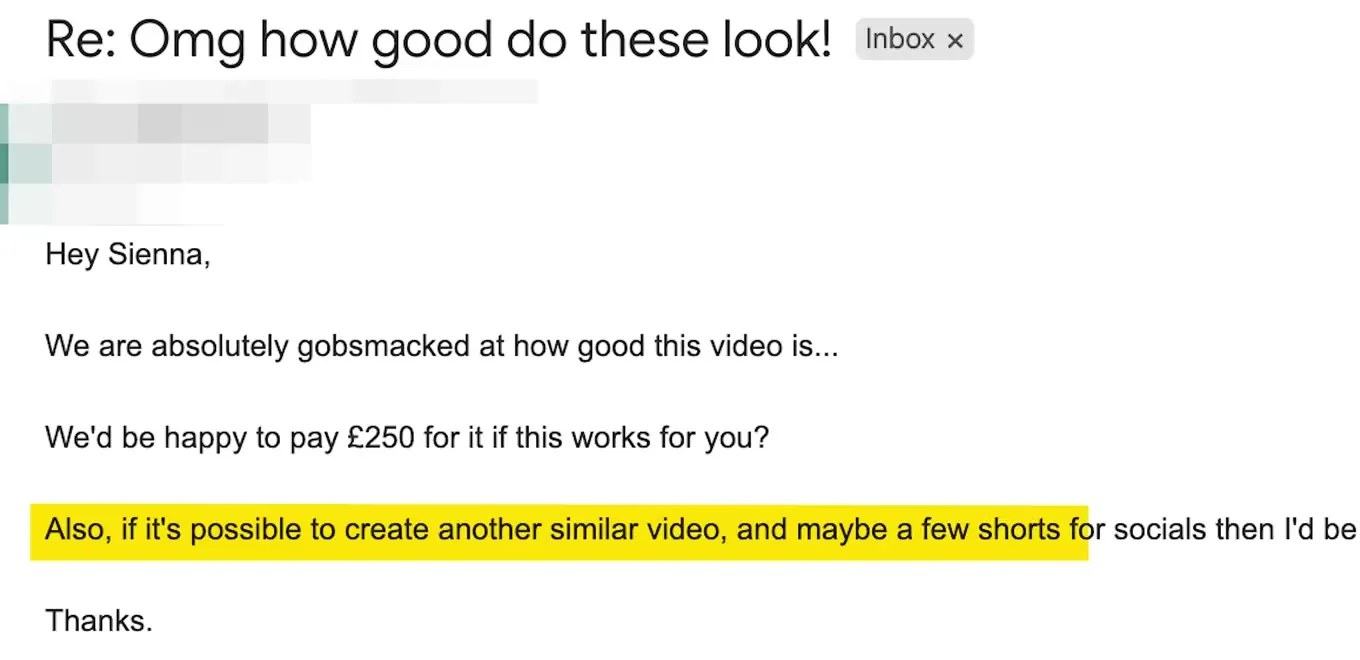
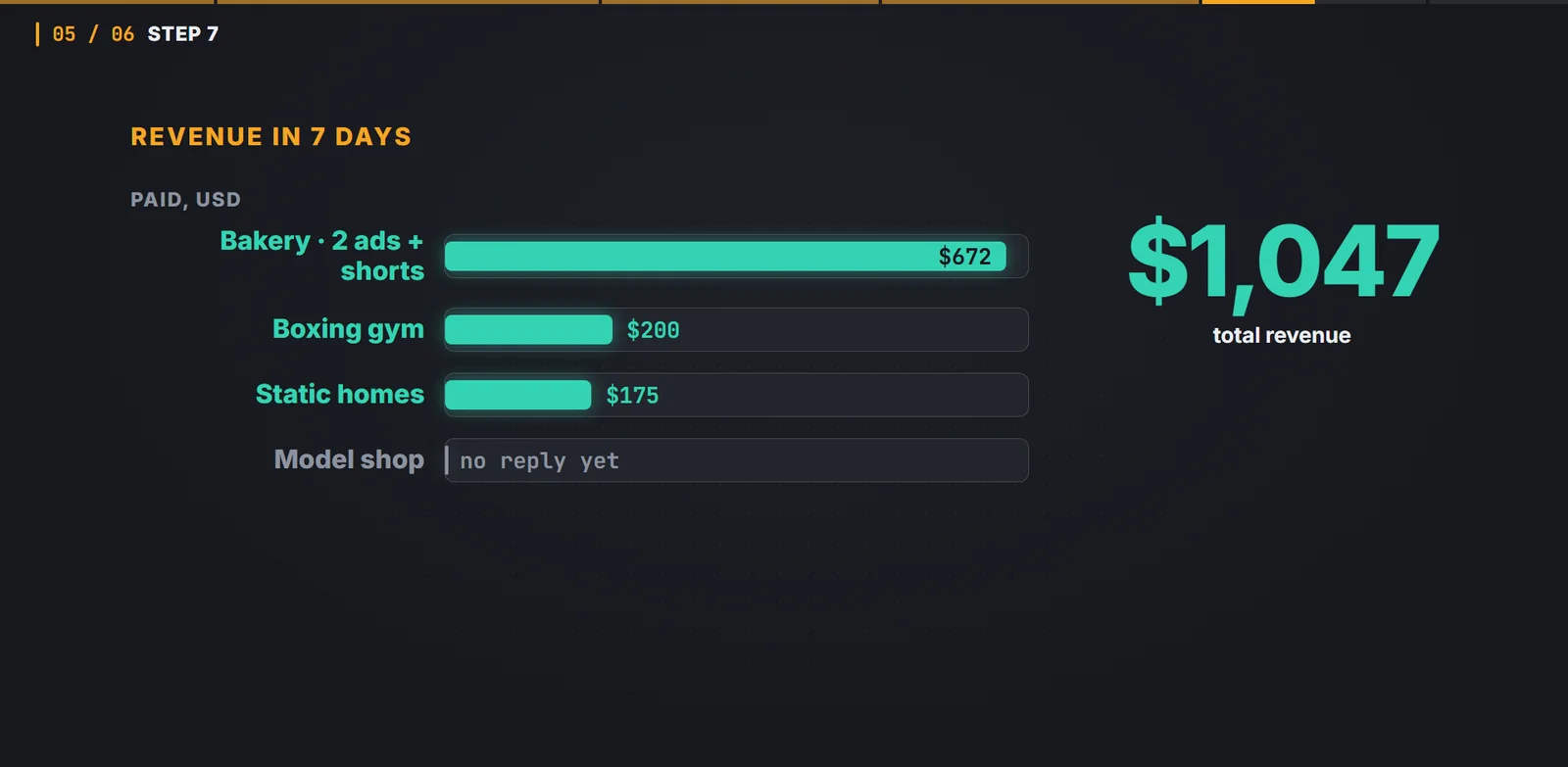
- The bakery loved its ad and offered £250, about $336. It also asked for another video and a few shorts for social media, for the same again. He made a second ad with an Alice in Wonderland feel and a couple of short clips for Instagram. Bakery total: $672.
- The boxing gym loved its ad and paid $200, and also wanted to recommend him to another business owner.
- The static home park said it was very grateful and paid $175.
- The model shop had not replied yet, so he could not count it.
Total revenue: $1,047 in seven days.
17. Costs: the part that changes the story
At first it looked like he had hit the target. Then came the costs:
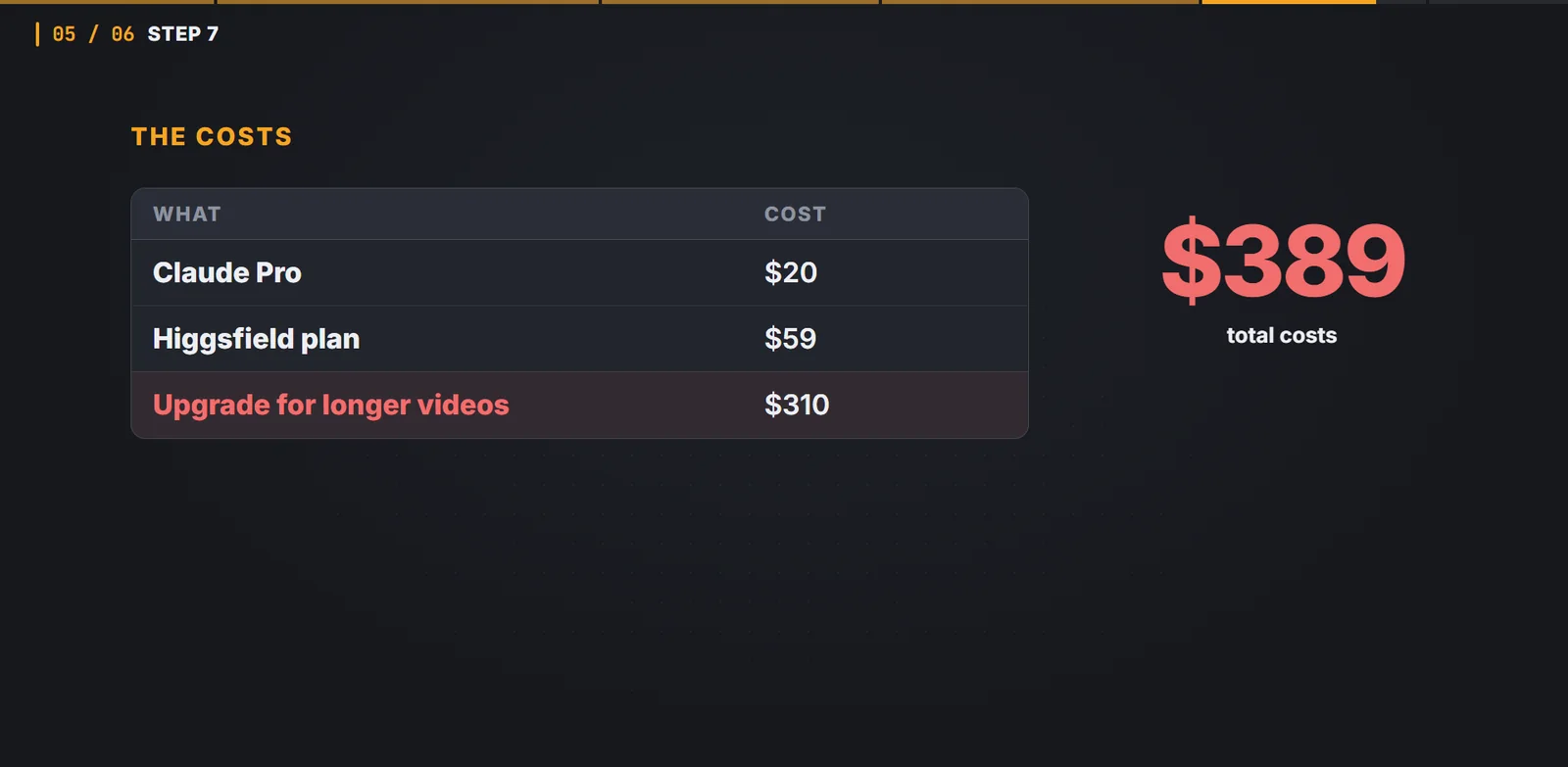
| Item | Cost (USD) | Note |
|---|---|---|
| Claude Pro | $20 | One month |
| Email account | $0 | Free |
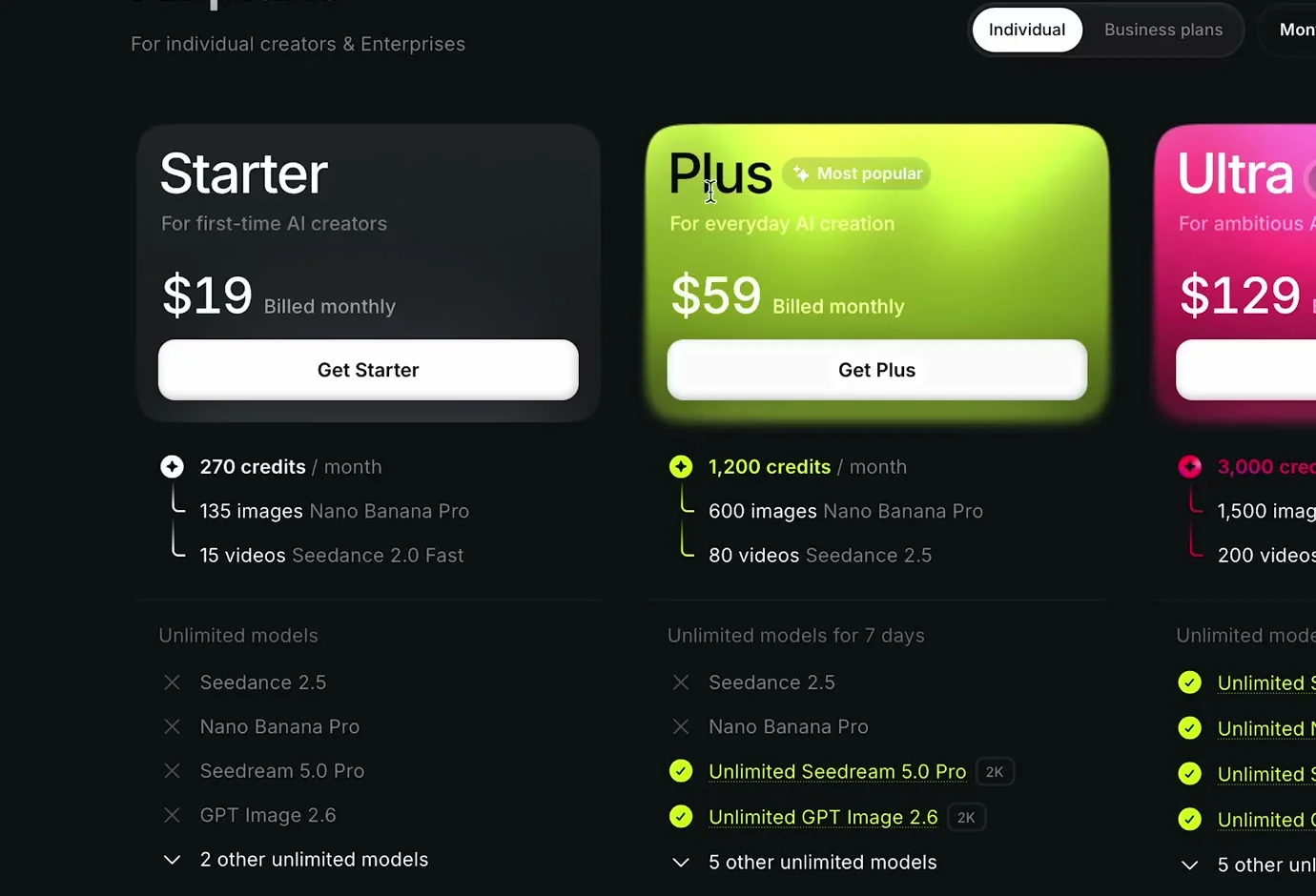
| Higgsfield Plus plan | $59 | Made every image and video |
| Higgsfield Ultra upgrade | $310 | Bought after the request for longer videos |
| Total | $389 |
He bought the upgrade only after some businesses had already agreed to pay, so he knew money was coming. Note that the image and video tool is the sponsor, and that the upgrade alone cost more than the boxing gym paid for its ad.
18. Profit, and the verdict
Revenue of $1,047 minus costs of $389 leaves $658 of profit. That is short of the $1,000 target, so, as promised, he is giving $1,000 of his own money to a commenter.
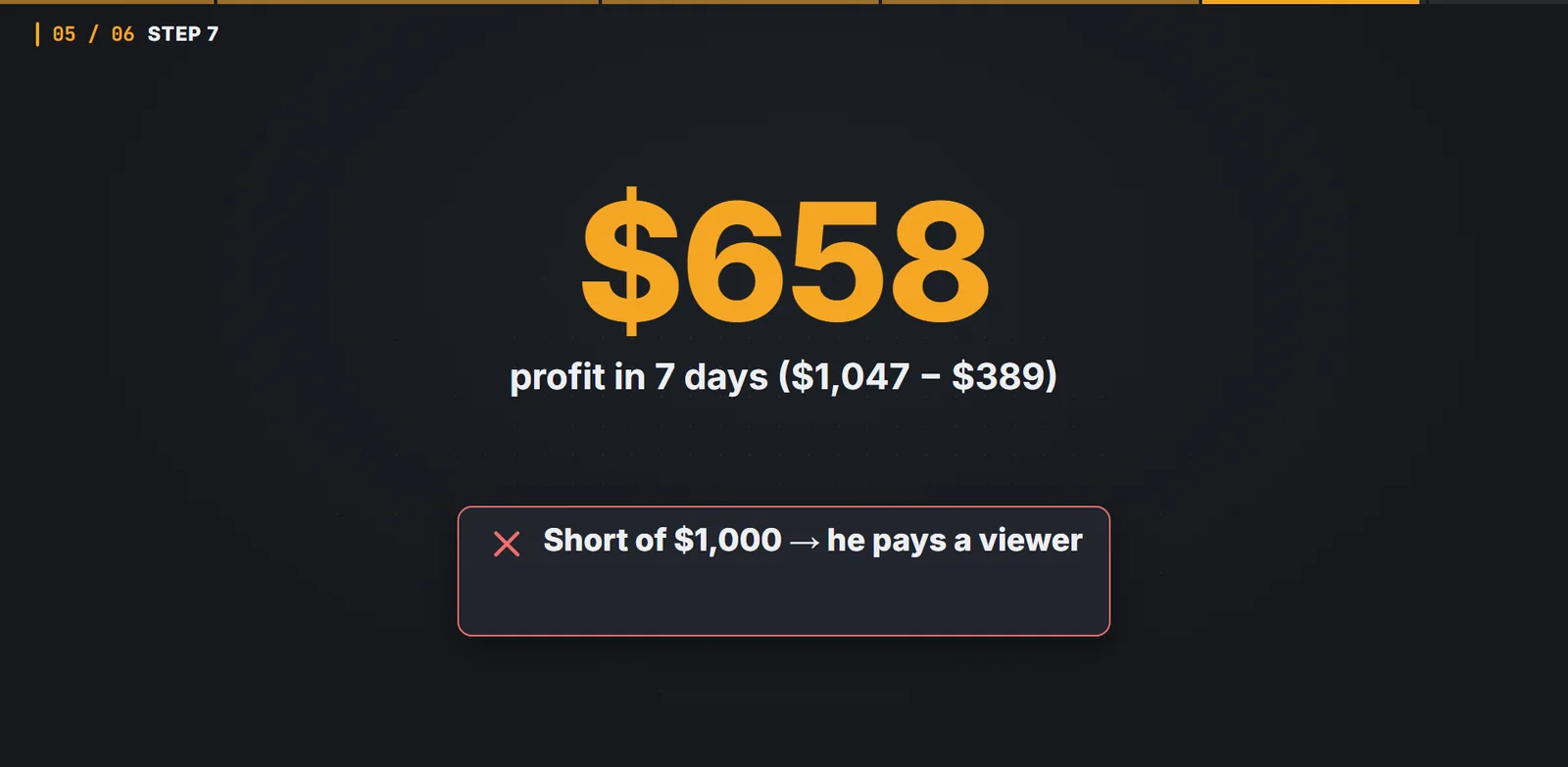
| Measure | Figure (as reported) |
|---|---|
| Businesses contacted | About 50 |
| Said yes | 4 |
| Paid within the week | 3 |
| Revenue | $1,047 |
| Costs | $389 |
| Profit | $658 |
| Target | $1,000 profit |
| Result | Missed; he pays a viewer $1,000 |
He argues the result undersells the business. The model shop had not answered and could have added what he guesses would be an easy $200. The gym’s referral brought a new prospect he never had to contact, and three more businesses asked for work after the deadline. In his words, this kind of business “starts off slow, but compounds over time.” That is his view, not a measured result; the challenge ended at seven days.
Final Perspective
Strip away the challenge format and the experiment is a small, honest test of a well-known model: an AI-powered creative service for local businesses. A few things clearly worked, a few are risky, and one number is worth remembering above all.
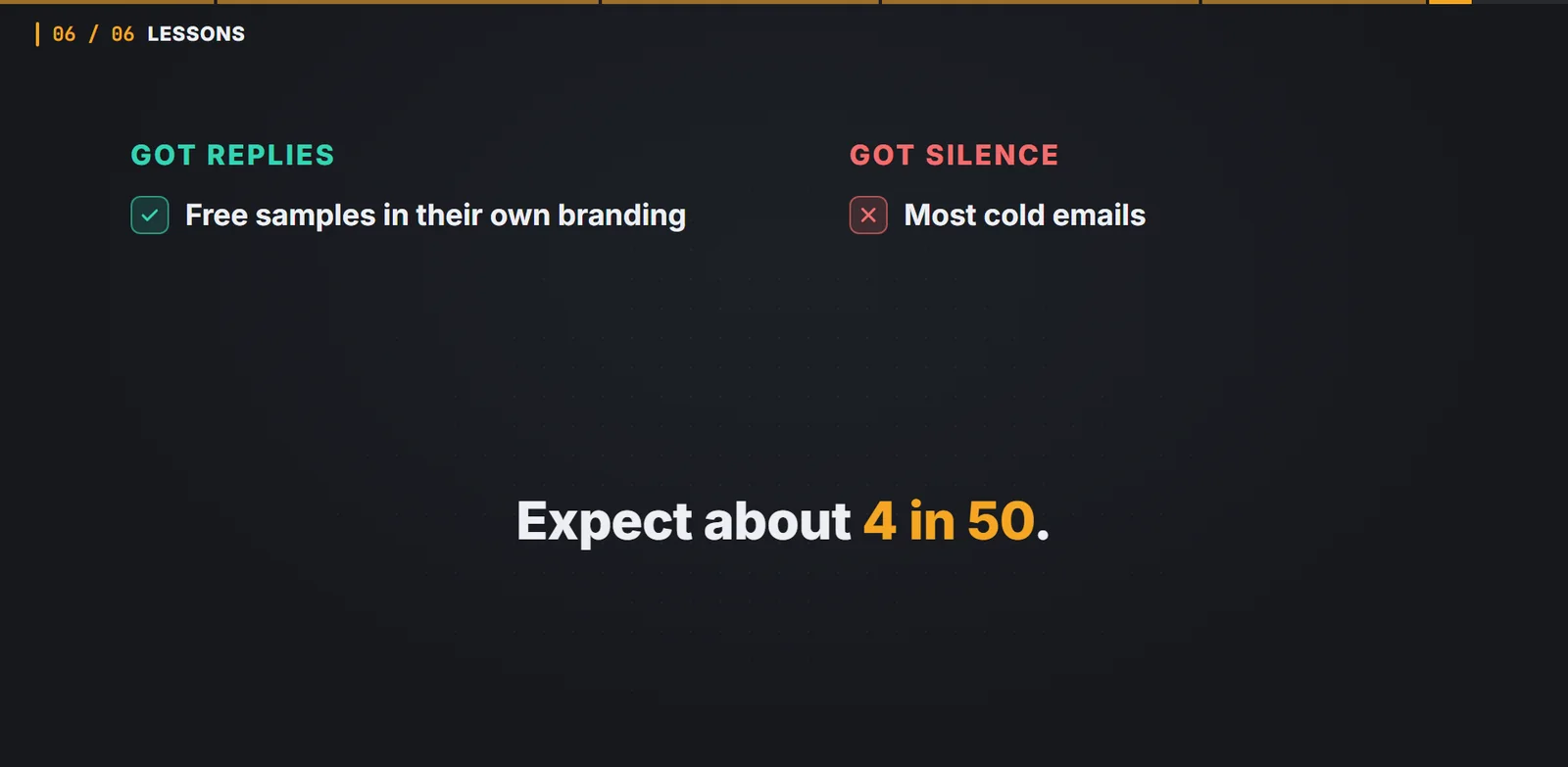
| Lesson | Why it matters |
|---|---|
| Free samples in the customer’s own branding open doors | The four yeses came after businesses saw their own products and boxes in ad-style shots |
| Expect about 4 in 50 | Most cold emails got no reply, some were hostile; plan the size of your list around that |
| “Pay what it’s worth” is a gamble | It made saying yes easy, but prices came in at a few hundred dollars, and a weak video could have earned nothing |
| Watch tool costs | The upgrade was the largest single cost and decided whether the week was profitable |
| Iteration is the real work | The first bakery cut was flat; the last two ads needed many rounds |
| Repeat business compounds | A second order, a referral and three late requests came from the same small start |
| Be careful with identity and AI labels | He used a pen name only for the test and does not recommend it; some owners reject AI work outright |
The sober reading: in seven days, with a famous creator’s production skills and a sponsor’s tool, the model produced $658 of profit on his own figures. It is a real start, not proof of easy income. If you try it, budget for tool costs before you have paying customers, keep the list large, and be open with customers that the work is AI-made.
Quick Reference
| Step | What to do | Prompt or tool from the experiment |
|---|---|---|
| 1. Pick | Ask Claude to choose one AI side hustle | “If you had to pick one AI side hustle for me…” |
| 2. Plan | Ask for a step-by-step plan with a deadline | “Give me a full step-by-step plan … making money within seven days” |
| 3. Target | Small independent businesses, not big brands | Google Maps, Instagram, Facebook |
| 4. Track | Keep every prospect in one sheet | “Build me a spreadsheet to keep track…” |
| 5. Tool | Connect an image and video tool to Claude | Higgsfield as a custom connector (Customize → Connectors) |
| 6. Samples | Give Claude the website and Instagram, then generate | Products, branding and slogan first; then ad-style images |
| 7. Outreach | Personal, short, lead with the work | Claude writes each email |
| 8. Offer | Full video, pay what it’s worth (or quote a price) | His choice was Claude’s; he would have charged up front |
| 9. Produce | Ideas → shot-by-shot script → character sheets → cut | “Improve the camera work … without changing the story” |
| 10. Count | Revenue minus every tool cost | $1,047 − $389 = $658 (his figures) |
Further Reading and Source Notes
- Source video: “I Built A Business From Scratch Only Following Claude’s Advice” by Mark Tilbury
- Video summary by AIBotRadar: “He Built a Business in 7 Days Using Only Claude’s Advice (Real Numbers)”.
- All figures are as stated by Mark Tilbury in the original video, including his pound-to-dollar conversion. The $500,000 and $20,000 to $40,000 figures are a report he cites, not his own results.
- The original video was sponsored by Higgsfield; this guide is independent and not sponsored. Screenshots are cropped frames from the original video, shown for commentary and education with credit to Mark Tilbury; diagrams are original.
Educational summary and commentary. All revenue, cost and profit figures are the creator’s own, as reported in his video; they have not been independently verified, and your results will differ. The original video was sponsored by Higgsfield; this guide is not sponsored. Not financial or business advice.